Showing posts with label Sci-Fi. Show all posts

Tuesday, 18 February 2014

Cross Stitch (Outlander)

The majority of my, sadly much reduced, reading of late has comprised me desperately trying to stay ahead of the seemingly endless adaptations that movie and TV companies are apparently never going to get tired of throwing at us. Most of these; Jonathan Strange & Mr Norrell, Divergent, The 100; and Bitten, which is next on the list, are books I would have read eventually anyway but the one I just finished was never even on my radar until Starz announced that they were adapting it. I speak of course, of Outlander.


Outlander, or Cross-Stitch as the UK edition is called; I was quite cross about this for a while, until I found out that Cross-Stitch was actually the authors original and preferred title so it's the Americans who should be annoyed, thank you wikipedia; is an odd beast. I liked it, don't get me wrong, but I wanted to love it and that just never really happened. It came close a couple of times, but never quite gelled properly for me.

Stripped to it's barest bones, the plot is nothing fiercely original; a time traveler becomes trapped in an era alien to their sensibilities, and must adapt to survive. In this case Claire Randall, a battlefield nurse fresh from the wars, is whisked back in time to Scotland on the eve of the Jacobite uprising; as well as dealing with the rising tensions between the English and their Scottish subjects, she must also tread lightly for fear of her modern attitudes, and indeed her modern medicine, getting her the kind of reputation you really don't want in a still massively superstitious culture.

And that right there, is a plot I want to read. Unfortunately, it's a plot that goes off the rails once the inevitable love story comes into play.

 Finding herself thrust into a marriage of political expediency Claire, in a shocking twist (which is so inevitable as to be revealed on the cover as part of the premise, despite not happening until a good few hundred pages into the book), falls in love with the man in question. Which is all well and good; except it isn't.

I'm not going to get up in arms about how she's already married and is therefore an adulteress, and a bigamist (maybe not technically; there's some admirably energetic doublespeak employed to explain why she isn't at all, no way, don't be silly. But, you know, she's married and she gets married again); which seems to be a major bugbear for some people, but I am going to have a problem with a couple of things.

Firstly, the much vaunted epic love between the two is completely absent in the first half of the book, when she is still looking for a way home and isn't looking at him romantically, before suddenly being shoved down our throats in as engineered and contrived a manner as I've ever read. She loves him because the author says she loves him, and the author says she loves him because, well, that's just what happens in stories like this. I think that if their relationship had continued in the 'grudging respect leading to deep friendship' vein of the early chapters, the book would have been the better for it.

Secondly, and I don't mean to be blunt, he beats her. It's presented in a matter of fact, 'that's just how they did things back then' light, and maybe it was, and maybe it would have been unrealistic to shy away from that, but the fact remains that while it may be the way they did things back then, it most certainly isn't how they do it where she comes from, and it's a betrayal of her character that she accepts it so readily. Yes, she protests, and yes, she makes token threats of what she'll do if he ever tries it again, but she is at his mercy, and he beats her, and she not only forgives him but their 'love' affair steamrolls from that point on. This is not a healthy relationship.

To be clear, I'm not talking about the controversial rough sex sections, which seem to cause as much consternation as the infidelity in some quarters; the record (and my google history) will attest that I have no problems whatsoever with that kind of thing between consenting adults, but the cold blooded, methodical, corporal punishment of a man who feels the need to control his wife... that left a bitter taste.

Moving away from the central relationship, we come to another problem, again on a sexual theme; homosexuality. There are two prominent homosexual characters in the novel, and while one of them is presented as an amiable and likable man who wins over Claire with his charm and wit, he's also a man with a long history of being predatory towards young boys lower in social standing  and power; a 'kink' that is treated as a running gag. And the other is a sexual sadist who may or may not have molested his brother when they were kids. I'm not saying the prejudice is intentional, but it's problematic, regardless.

Then there are the plots that go nowhere, such as the Nessie style monster and the second time traveler. Both are presented as being a big deal; both fizzle out well before the climax. Hell, even Claire's efforts to get home are abandoned halfway through the book and her poor first husband all but forgotten about. In fact, I'm doubtful you could even say the book has a climax; it more just sort of dawdles along to a vague happy ending with the leads having run away and ignored their problems.

Now, maybe this stuff will be dealt with in the sequels, I don't know, but the fact is that this book wasn't written as the first in a series, and wasn't sold as such. As a standalone novel, it's a bit of a hot mess.

But, lest we forget, I did say that I liked, if not loved it. Why? Well, the aforementioned friendship between the leads was very well crafted before it devolved into the very dodgy sexual politics of their married life; the depiction of life in Scotland under the yolk of the English is evocative (if a little on the nose) and the political intrigue of the Clan power machinations is gripping stuff, even if it does fizzle out with the rest of the decent plots a hundred pages before the end.

Gabaldon is a good writer. Her prose is dense, but never so much so as to confuse or bore, and her characters, when they behave like human beings and not robots servicing a plot, are well drawn and for the most part likable. Let's just hope the sequels; which I will be reading; have a tighter focus, and a surer handle on their characters.

Diana Gabaldon

Friday, 11 January 2013

Catching Fire


Christmas eh? And New Years? Who'd have em? Exactly. And so on and so forth. You get the drift.

Anyway, first post on here of 2013! I ummed and aahed
as to what to do but in the end there was one choice really; I would delve back into my frantic attempts to catch up with what everyone else read two years ago.  So without further ado, I give you...


Katniss Everdeen survived the Hunger Games but in order to ensure that friend and potential love interest Peeta did too she had to embarrass the organisers, and by extension the administration of creepy old President Snow; an act which has made her an unwitting, and indeed unwilling, symbol of hope for a burgeoning resistance movement. All Katniss wants to do is be left alone, but let's face it; she's the lead in a trilogy, and is only one book in. She's not getting an easy life any time soon; that's just science.

Sure enough, President Snow comes up with a way to strike back at her for her impertinence (and keep the series going); he re-jigs the entire concept of the Hunger Games to get past winners back in the arena, and since Katniss' native District 12 doesn't have that many to choose from, it's back to the Capital she goes.

Catching Fire isn't really about  the games themselves though. The Hunger Games took a while to get Katniss and Peeta into the arena, yes, but the main thrust of the plot was the games; here we have to wait even longer before the games start, and when they do it's clear from the off that something isn't quite right with them.  

There is a much greater amount of time spent establishing the other entrants in the games this time around; presumably because they are going to be important later, as opposed to the first book's glorified cannon fodder; but Collins does it with a sure hand, never once allowing them to distract her too much from the job at hand. That being, making Katniss annoying.

And that, right there, is the rub of the nub. Sorry fans, but as much I enjoyed this book there is no getting away from the fact that Collins has fallen prey to the same pitfall that so many others before her have fallen into; namely, having a first person narrator who is the least interesting, and most annoying, character in the story. And I say this as someone who praised the Katniss character in my post on the first book.

For some reason all of her 'quirks' and the little annoyances that I forgave the first time around just seemed amplified in this book and made it harder and harder to like the girl. Maybe I'm being dense; maybe the point is that we aren't supposed to like her. In which case, well done, mission accomplished.

Plotwise, however, the book is fantastic. It takes what could have been a carbon copy of the original and turns it on it's head, while the finale; uber exciting action set piece that it is; sends the characters, and the entire series, off in a totally new direction that there is no coming back from. Mockingjay is going to be something else.

Suzanne Collins

And that was my, somewhat less than any good at all post on Catching Fire. I really did enjoy it. A lot. Honest.

Next week will see the blog play host to a collection of comics featuring everyone's favourite immortal mystic, Madame Xanadu. See ya later.

Friday, 16 November 2012

The Hunger Games

Another of my 'where the hell did this come from and how can there be 3 books already and everyone has already read them and they're making a movie and no-one will shut up about them and I'm going to be spoiled on everything before I open the first book and oh god whatever, just give me it I'll read it now' posts this week.

For the record, I hate when I'm forced to let books jump the queue in order to avoid spoilers. I need my incredibly complicated and strict system of what I read when to remain intact if I don't want the universe to implode behind my eyes. So thank you, spoilery people!


Anyway, I've read The Hunger Games.


You all know the plot; young girl volunteers to take part in a fight to the death against a bunch of other youngsters to prevent her little sister from being drafted; she and lots of other kids, some nice, some not, are shipped into an arena and start killing each other; rich folk get their jollies by watching; it's all a propaganda/morale crushing technique used by corrupt government to keep the populace in line. It's not a hard concept to grasp.

Much has been made of the unoriginality of the concept; with most citing Battle Royale as the victim of Suzanne Collins 'plagiarism'; because people haven't been rewriting the Greek myths or Shakespeare's plays for centuries, have they?

I once read an interview; and I can't remember where it was, sorry; with Terry Pratchett. He was being asked about a certain big hotshot new author who was making a killing with a bunch of stories based around a school for magically inclined people. Unseen University, anyone? Perhaps the interviewer was hoping, though they never came out and said it, that they would get a bitter rant about ideas theft. If they were expecting that, they were disappointed.

Instead what they got was common sense. He was far from the first to write stories about a school for wizards, and never expected to be the last; when you're working in the fantasy genre, some items are universal, one might even say generic; and what crime had this author committed, other than to get an awful lot of young kids who never would have otherwise to read books? You tell 'em, Tel!

I read an interview recently with Suzanne Collins, where she addressed her inspirations and thought processes behind The Hunger Games. While you'd expect her not to come out and say 'yeah, you got me, I'm a big old hack who nicked her story', the reasoning she did profess was so solid, in-depth and obviously genuine that you'd have to be the most cynical man alive to think she was making shit up to cover her backside. It's churlish and it's mean and it's disrespectful; so stop it.

Rant over. So what did I think of the book itself? Well, I'll tell you.

I loved it. The end.

Ha, that's not really the end. Me needs to waffle.

Katniss Everdeen is an engaging heroine, tis true, even if she is saddled with the tension killer that is a first person narrative; I really don't like them; and it's a good job she is because if you weren't happy in her company you'd find the first half of this book very boring. Not because nothing happens, but rather because nothing that you expect, happens; you go into a book about gladiatorial combat to the death and you expect people to be killing each other, so the fact that it takes almost 200 pages for the contest to begin is bound to be a bit of a drag.

Don't get me wrong, the opening sections do a masterful job establishing this world, and a sense of history, and manage to make the many districts and their respective populations truly distinct; in a way that the movie never quite managed; but it just takes a little too long to do it. I can't help but feel that a happy medium could have been found between the books languid pace and the overly rushed opening of the movie. Never mind.

As a consequence of the first person narrative; I really don't like them; the secondary characters are of course only seen through Katniss' eyes. For characters like Gale and Peeta, the two boys who form the inevitable love triangle with Katniss that all teen novels seem obligated to have, this works; Katniss is confused and unsure about how they feel about her, so the reader needs to be too. Up to a point, of course, because while Katniss may be oblivious to the romantic aspects of life, having grown up worrying more about putting food in her belly than her next kiss, you'd have to be pretty much an idiot to not get where this story is headed. Collins understands this though, and gets around it quite cleverly by giving just enough of a wink that you know she knows you know...er you know what I mean; before long the reader is in on the joke, and is allowed to feel that they're ahead of the character.

The much ballyhoo-ed violence is not, to be fair, as bad as some would have you believe; though still quite nasty in places; but rather it's the emotional shock that packs the weightiest punch. One death in particular, which you know, intellectually, is inevitable, still manages to knock the wind out of your sails when it comes and I will freely admit that I had to put the book down when I read it. Even the (inferior) movie version of the scene got a tear from me, I'm not too proud to admit.

The book stumbles a little in the big finale. If you saw the movie and thought the final bit of peril came out of nowhere and seemed tacked on you'll be pleased to hear that there is a proper explanation for it in the book, and a nasty and chilling one at that, but it still didn't quite work for me, and seemed maybe a step too far into the fantastical. I'm actually glad that the explanation wasn't used in the movie, because I'm not convinced they'd have been able to get it across in a way that made sense.

Slight pacing issues at the start, and a cluttered finale can't detract from what is, without a doubt, a brilliant, tense, thrilling and ultimately moving piece of work by Collins. which had me grasping for the sequel immediately. Highly recommended.

Suzanne Collins

Friday, 9 November 2012

The Boys: Get Some


Comics this week, with Volume 2 of Garth Ennis and Darick Robertson's The Boys,  entitled 'Get Some', from the 4 part arc that opens the volume.


And what an arc it is! I've seen some criticism elsewhere on the internets, even from those who were complimentary about volume one, that this book sputters a little; that having used up all the obvious jokes in book one Ennis struggles to segue into an actual proper plot. I couldn't disagree more.

An investigation into the death of a young man that the police are suspiciously keen to close the file on leads cockney psycho Butcher and fish out of water new boy Hughie to poke their noses into the world of high-tech costumed vigilante Tek-Knight and his assorted allies and enemies. Which couldn't come at a worse time for Tek-Knight, who's having some 'emotional issues.' Namely, he can't stop fucking anything vaguely resembling a hole.

Unlike the majority of superhero characters that we've met so far, Tek-Knight seems like a relatively decent chap at heart, who's genuinely torn up about these compulsions; one suspects that any of the supes we met in book one would have embraced it, or not even noticed the difference, so depraved have they allowed themselves to become, but TekKnight does everything he can to resist. The scene of him undergoing therapy is, while very much played for laughs; the incongruity of him in his huge suit of armour, hunched up in a very proper Doctor's office is comedy gold in itself; you can't help but come to like the guy, and sympathise with him.

Tek-Knight gets some help
The ending to Tek-Knight's story is one big sex joke, it's true, but it's also a genuinely stirring and moving moment. That it is instantly undercut by more gags is par for the course; Ennis doesn't let you wallow; but that doesn't change what it is.

That's one of the things the Ennis detractors continue to be oblivious to; he uses the smut and the gore and the creepy sex gags to lull you into thinking you're reading a juvenile bit of fluff, so that it hits you even harder when moments of true joy, true sadness, or true beauty come at you. The criticism that his work is just swearing and tit jokes could have had some credence in the early years, when he was writing Hellblazer or Preacher, because he hadn't yet shown, as he would as those series developed, just what was going on under the surface; that those criticisms are still being thrown at him today beggars belief. And they are; I read a recent article to that effect when looking up some stuff for this post.

Anyway, with the murder solved and the Tek-Knight story ended we get another arc, and if I tell you it's called Glorious Five Year Plan I should think you'd be able to guess where our intrepid heroes are headed for this tale. Need another clue? It's really cold, and they're fond of vodka.


This story begins to delve into the deeper political machinations that are going on behind the scenes and show us that while the bulk of the action is US based, these 'bad guys' have global intentions. It also has an incredibly bloody finale, with a truly massive body count, which is always nice, but the true joy is in new character Vasili Vorishkin, aka Love Sausage, Communist superhero turned bar owner. I mean seriously, Love Sausage.

As I say, this story delves into the deeper workings of the conspiracy at work in The Boys world but as this is only the 2nd volume it doesn't give us too many answers. What it does do is make it abundantly clear that the people we need to fear, the people who are the true 'villains' of this series are not the superheroes, arrogant abuse of superhuman abilities notwithstanding, but the humans; the corporations in fact; that are pulling their strings. There's probably a message there somewhere.

I adore this series, I'm not going to lie to you. It can be hilarious one moment, moving the next, and horrific the moment after that: then it'll throw in a moment that's all three at once, just to keep you on your toes. I'm reading nothing else like it, and I really don't want it to end. Lucky for me then that I'm so far behind, and have so much still to come.

Friday, 12 October 2012

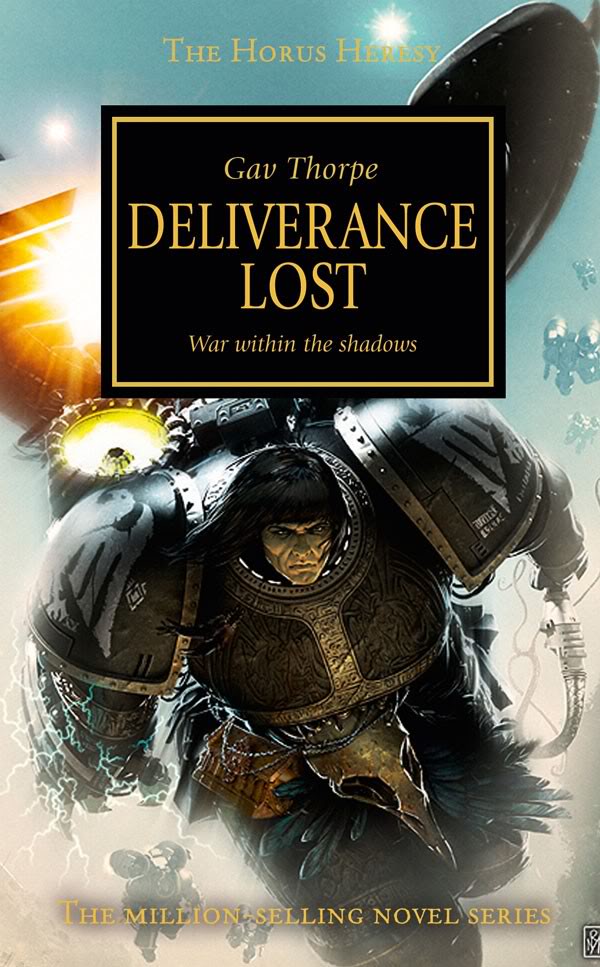
Horus Heresy: The Outcast Dead/Deliverance Lost


Since last I spoke of the Horus Heresy series, I have read not one, but two further novels in the series; The Outcast Dead, by Graham McNeill and Deliverance Lost by Gav Thorpe. And now I shall make discussion of them, as is traditional. 

It's been a while since I read them though, and I've read a few other things since then, so I'll not do a full analysis (hahahaha shut up, you know what I mean) but rather just a quick comparison between the two, and why they are, taken back to back, such a good example of why I enjoy this series so much, even after having read almost 20 books. 

Which is not to say that they are good books, necessarily. 

In fact, Deliverance Lost is pretty much the definition of a poor book, and The Outcast Dead, while better; as you'd expect from Graham McNeill; is far from without it's flaws. 


It's in their subject matter, rather than the quality of the work involved, that they serve as good examples of the Horus Heresy series' current charm; namely, it's versatility. In the early days of the series it ran the risk of, and often succumbed to, repetition; so many novels, by so many authors, all recounting this Space Marine battle or that one, but the wider ramifications of the great betrayal at the heart of the series, and the intricacies of how this Universe actually functioned, were never explored; or  if they were it was in a perfunctory manner designed to give you just enough information to herd you to the next gunfight. 

Of late, things have changed.

We'd had hints of a new direction for a while; notably, but not exclusively, in the 13th book, Nemesis. It was with book 16 though; novella collection Age of Darkness; that they fully embarked on their new direction. These two books embrace that change wholeheartedly, with TOD dealing with events among the 'little people' on Earth for the first time, and DL, while it does deal with Space Marines and has a couple of battles, has as it's main focus a story of obsession, genetic engineering and espionage. As I said above, neither book is entirely successful and DL falls apart completely at the end but it's pleasing to see these new avenues being explored, and new story telling roads being traveled. 

I'm not suggesting for one second that Space Marine battles should be excised completely from the series; it's entirely based on a tabletop game involving Space Marines shooting each other; but it's nice that they're acknowledging that they have created, perhaps by accident, a Universe ripe for exploration. Some very good writers ply their trade in the Warhammer/Warhammer 40,000 tie-in range; as well as some very bad ones of course; and it should be interesting to see what they come up with now that they're free to spread their wings. Mistakes will be made, like Deliverance Lost, but when they find their rhythm I predict some excellent space opera could be forthcoming. Can't wait.

Friday, 15 June 2012

Seizure


Tory Brennan and her friends Hi, Shelton and Ben are, along with wolf pup Cooper, the Virals; a psychically linked 'pack' who, as a result of exposure to an experimental virus have achieved, in addition to the aforementioned psychic link, heightened senses and varying degrees of super speed, strength and agility. Unfortunately they also seem to have gained a heightened ability to get themselves mixed up in weird and dangerous situations as well.

The first book in the Virals series; called, appropriately enough, Virals; told of how the gang got their powers, and their subsequent efforts to bring down the nasty scientists and mobsters responsible, whilst simultaneously keeping said powers secret. I mean, you would, wouldn't you? No-one likes being vivisected.

Book 2, Seizure, is having no truck with that though and sets about examining what the kids will do with their new abilities. Which, it turns out, is hunt for buried pirate treasure to fund their parents lab so they don't lose their homes and have to split up. So basically, The Goonies.

Reichs doesn't attempt to disguise the similarities, even going so far as to have characters mention the movie in conversation. But acknowledging an influence doesn't relieve you of guilt if you don't live up to it; if anything, I'd say it's quite the opposite; and this book in no way lives up to the legacy of said movie. Sadly, it's The Goonies with all the wit and charm replaced by stilted dialogue and science lessons.

Reichs can tell a story, that much should never be in doubt. The problem is that she can't tell this story. Her background is in forensic anthropology, and her 'day job' of remains identification; be it for disaster relief, war zone/genocide clear up or, ore often, law enforcement; is shared by the heroine of her 'adult' novels, Temperance Brennan. As such, Reichs' technical jargon and propensity for lecturing the reader in aspects of her discipline, sits easily in the context of those books. Of course coroners and cops and the like will talk in those terms. Teenagers, however scientifically minded, will not. There isn't a single character among the 'Virals' that comes across like an actual teen.

This could have been a thrilling adventure story. And when she lets herself go, it is; she's certainly capable of writing a decent action sequence. But it's too inconsistent, and all too often she falls into the trap of having her characters explain the plot to each other in a huge chunk of techno-babble. Suspension of disbelief becomes impossible.

Of course, I'm going to keep reading regardless. Not because I'm particularly enjoying the series but because I am still enjoying the Temperance Brennan books and, on an intellectual level, I'm eager to see how the two series co-exist. Reichs is playing a little bit fast and loose with the rules of fiction lately and I'm intrigued as to how she keeps it up.

Not only does she have Tory and her father sit down to watch Bones, a TV show based on novels which, one would assume, don't exist in their world, since they feature a member of their family as a fictional character (and Tory's father has actually appeared in a couple of them himself), but we also have the fact that both the Tempe and Tory Brennan books are existing in the same world; Tempe has mentioned her niece in her books, and Tory has asked her Aunt for help in the Virals books, but the Tempe books are straight thrillers with a hard science basis and the Virals books are, by their very nature, delving into the realms of sci-fi. How closely will she allow them to interact? And will she come a cropper because of it?

I'm not wishing for her to fail. Far from it in fact; I thoroughly enjoy her adult books and genuinely hope she finds a more distinctive voice for her YA work. I just don't think she will.


Wednesday, 18 April 2012

Horus Heresy : Age of Darkness


As the seemingly never ending quest to catch up with the Horus Heresy series trundles ever onwards we come to Age of Darkness, which marks a pretty significant turning point in the series.

After the opening trilogy the Horus Heresy series series very quickly moved away from having any kind of traditional linear narrative. Books would explore previously described events from a new perspective, or flash back to show how characters arrived at their roles in the opening story; some going back years, decades, even centuries. Very rare was the story that progressed the plot much beyond the massacre on Isstvan V that closed the 3rd book. Until now.

Age of Darkness is a collection of novellas from various writers; some established contributors to the series, some new names. The stories continue the series tradition of jumping around in time, but with a much narrower window, and one that's looking in the other direction. At last, we get to see the after effects of the Isstvan V event.

Some of the stories are better than others, as is to be expected in any anthology format, and which are the good and which the bad will depend, in this case, on what you want from this series. For many people; those who came to the books from the games; I would imagine a large part of the appeal lies in the weaponry and the technology. For me though, it's all about the world building, the politics, the people and the subtler side of the war.

With that said it's perhaps unsurprising that I was drawn to Liar's Due, by James Swallow; a tale of how propaganda can be used to conquer a people without firing a shot; and The Iron Within, which while on the surface is a fairly basic battle story, also tackles the issue of individuals having to decide whether to follow immoral orders. This latter story deals with something I'd been thinking about more and more as I read the Horus Heresy series; we are told that this Legion or that is on one side or the other of the rebellion, but what are the chances that everyone within those Legions is going to follow suit? It can come across as overly simplistic, if examined too closely, but this story at least addresses the issue. Whether it will be looked at again as the series progresses is something we'll have to wait and see about.

My other favourite story, which will come as no surprise to anyone who has the vaguest inkling of my tastes, was Little Horus by Dan Abnett; partly because it delved into the psyche of an important character that we seldom see, though often hear about; and partly because it employs a favourite trick of Abnett's which to me at least never gets old; that of repetition. As in his last HH novel, Prospero Burns; in which a major character experiences a recurring dream, which is always almost exactly the same until the point of waking, whereupon the dreamer comes a little closer to learning the point of the dream each time; Abnett uses repetition here in his description of his title character, right up to the line "Then again, once they (redacted for spoiler), all he ever looked was..."

It's a clever ploy which ensures that the final iteration of the line; the final line of the story; hits home hard. We come away thinking exactly what he wants us to be thinking about this character, and what I'm sure we need to be thinking about him, going forward, since he's almost guaranteed to be back down the line.

I'm hoping, given that all of these stories take place post-Isstvan and the cover tells us "A new chapter begins", that we are going to see the story move forward into the post massacre period permanently. I've enjoyed the flashbacks, and as someone who comes to the books fresh; not having been a gamer; they've been a boon in terms of getting to grips with the world, but we're nearing 20 books, now, in the series and the time has come I think.

Friday, 10 February 2012

The Boys: The Name Of The Game

Comics again this week, which means two posts in a row, which kind of breaks the rules I imposed for myself but to be honest, I'm reading a lot more comics than books at the moment, so needs must, as they say. So what we have here is another example, after my 100 Bullets and Fables posts, of me looking at Book One of a series everyone else has already finished, or is waiting for Book 72 of. Like it or lump it though, because it's what you're getting.


Ah, Preacher. Preacher, Preacher, Preacher. When I was a young fella, way back in the dim and murky depths of prehistory (I think it was in the mid 1990's), the Judge Dredd Megazine was going through one of those 'We aren't making any money so we need to fill up on cheap reprint until we can balance the books. We'll brand it as a New Look and hope no-one notices' phases that it occasionally suffered, (I am not criticising this policy. It kept the title alive, when things were grim)and the result was that they took to reprinting Preacher, by Garth Ennis and Steve Dillon.

It blew my mind and years later was the catalyst for my very first venture to a comic shop, when I decided to pick up collections of the many issues the Megazine didn't re-print. The rest is history. I suppose it's no surprise then that Garth Ennis has implanted himself as my most favouritest of comic book writers.

Sadly, his creations after Preacher were, for the most part, a collection of mini-series and one shots. Another major epic was conspicuous by it's absence. War Stories, Dan Dare, Streets of Glory, Wormwood; they were all awesome works, but they weren't showcasing just what a master of the long form Mr Ennis is.

Enter The Boys.

The Boys are a team of people, loosely affiliated with, but not controlled by, the US authorities. Their job, though it's more of a calling, is to 'police' the Superhero community. All done under the table and on the down low of course, because it wouldn't do to have the general public find out that the 'Capes' are anything less than paragons of virtue. And that's basically the plot, although in true Ennis fashion you know that not everything you see in these early, premise establishing stories, will be what it seems.


I'm not as versed in the 'behind the scenes' of comics as I am in the world of TV but even an amateur like me is aware of Garth Ennis' somewhat less than reverential attitude toward the big name superhero franchises that are endlessly churned out by Marvel and DC, so it's perhaps to be expected that his take on the subject would be somewhat irreverent but what we get here in this 1st volume is more than I think even his staunchest fans would have expected (or his staunchest detractors would have dreaded). Simply put, the man is merciless.

The first collection is entitled The Name Of The Game and collects the first two arcs, following the eponymous opening two parter with the four part 'Cherry'. 'The Name...' introduces us, in time honoured fashion, to the new man on the team, allowing us to become acquainted with The Boys through his eyes while over on the Capes side of town, a new girl is being inducted into the ranks of the big guns, giving us a handy introduction to those characters too. And they are most certainly not your Daddies superheroes. Even if they do look very similar.


You might, at first glance, think that he slays a few too many sacred cows in what is, after all, supposed to be a launching pad for an ongoing series; when you take down all the obvious targets and make all the obvious jokes, where do you go next? But therein lies the genius. By making the 'inevitable resurrection' gag at a superhero funeral; by making the Superman analogue an arrogant prick; by having the superheroes squabbling among themselves over who gets top billing; and by doing it all in the first few issues, Ennis has taken what many assumed to be the main 'gimmick' of the book and used it as shorthand to establish the world we're going to be living in for the next however many issues. Now, he can get on with what the series is really about.

And what is it about? Well if the hints we get here are anything to go by, it's about power, and the abuses thereof; it's about love conquering all (or not), in a Romeo and Juliet stylee; and it's about how the Black and White morality so beloved of our four colour heroes just doesn't hold a lot of water, when it's exposed to the 'real' world.

Of course, I could be wrong. Maybe it's just about 2 groups of sociopaths kicking seven bells out of each other. Either way, it's very very violent and very very funny. I love it to bits.

Now to the art and as usual when I discuss comics, I can only apologise to the artist for paying him short shrift and having no clue what I'm talking about.

Darick Robertson is the name in the frame and he's an artist whose work I'm unfamiliar with; and yes, for those of you who know about this stuff, that means I haven't read Transmetropolitan. It's on the list.

Wee Hughie
Robertson's art suits this book to a tee. Going from 'realistic' portrayals of people for the serious stuff, to a more exaggerated cartoony look for the humorous moments and into pretty bloody brutal for the violence scenes, all while never seeming to change that much at all (I'm not describing this very well), it never looks anything less than stunning. And since it seems to be the law that this fact must be mentioned, check out the pic of Wee Hughie in this post; Robertson draws a mean Simon Pegg.


Garth Ennis


Darick Robertson

Friday, 17 June 2011

Horus Heresy : Nemesis


When last I spoke on here about the Horus Heresy series it was regarding the novel Mechanicum by Graham MacNeill. I spoke of liking the novel because it focused far more on the character interactions and much less on the technological aspects of the story. When the book which followed Mechanicum, Tales Of Heresy, turned out to be a collection of short stories rather than a novel I was buoyed by the fact that several of said stories moved even further down that trail, exploring the wider world that the series is set in and giving us a couple of lively and engrossing character pieces that had no need of genetically engineered supermen laying waste to entire worlds to generate drama. I inferred from their inclusion that the series as a whole might be in the process of widening its horizons somewhat, which pleased me.

Don't get me wrong; I've nothing against a bit of the old uber-violence now and again and after all, this is a series about a massive galaxy wide civil war set millenia in the future so there was always going to be a bit of tech and bravado involved; but I do think that a little bit of variety would stand the series in good stead. I mentioned at the time to a colleague of mine that perhaps a novel set in the shady political corridors of power might be a good idea, or an espionage novel set in this world. There had to be spies, right? In a war that big of course they were there. Sadly, what we got instead was two more novels about Space Marines blowing up aliens and then having a go at each other with their big guns and massive ships. Business as usual. Good stuff, but nothing especially original.So imagine my surprise then when we got Nemesis, by James Swallow as the 13th book in the series.

Almost completely eschewing the world of the Astartes (Space Marines), apart from brief moments in the prologue and epilogues and a brief but bloody and shocking cameo at the mid way point for an Astartes we'd seen before in the books, Nemesis focuses on the shadowy world of political assassination, with both sides despatching agents to assassinate the figurehead of the other. Leaving aside the fact that we know both sides will fail, because the series is a long way from over, the change of focus works well, allowing for a much more intimate look at the characters.

For much of the first half of the book we follow two stories; first, the formation of the team sent by the Loyalists to assassinate rebel leader Horus and then the events that unfold when they actually go out on the mission; and second, the story of a policeman on an Imperial world, investigating a series of ritualistic murders while his world suffers under the weight of rumours concerning the imminent arrival of Horus' rebel forces. As the story progresses into the back half, though, this strand takes a very dark - or darker - turn, and we realise that with this storyline nothing is what it seems.

I'm not massively versed in the futuristic Warhammer universe - the Horus Heresy books being my only foray into it so far - so it's likely that I'm not doing a very good job of describing why this book is so different from what has come before, or why I'm so pleased that it is, despite having enjoyed those earlier stories, but it is and I am. I sincerely hope that the wait for James Swallow to contribute another book to this series is not as long as the last one (he previously supplied Book 4), because he has proved himself here to be an author who can absolutely nail what I want more of in these books.

Friday, 29 April 2011

Warcraft and Starcraft


Death Note aside, I've not read a lot of Manga. In fact, I'm so ambivalent toward the entire concept that I'm not really at all fussed whether or not I'm correct in my use of the actual term 'Manga'. Have I fallen into some trap of the "Oh my God, they're not ALL Manga, that's a brand name/publishing house/mis-translation/etc." persuasion? If I have, I don't care. Which is not meant as a slight or disrespect or anything like that; it's just that the whole 'scene' is so far below my radar that I don't need to know the terminology. I have far more important things to worry about, like the correct reading order of the Tom Thorne books, or whether DC are ever going to publish a complete Hellblazer run (signs are promising, I'm told), or remembering the status of the major players in the decades between Song of Ice and Fire books.

Anyway, Death Note aside, I've not read a lot of Manga. Until now. Well, sort of. TokyoPop, publishers of various Manga titles, released, a number of years ago, a series of books based around the worlds, histories and legends of Warcraft and Starcraft. These being, of course, very popular online role-playing games. (I think. I know less about role playing games than I do about Manga.) Warcraft is a fantasy sword and sorcery type thing and Starcraft is a space opera.

Amongst other titles based on these properties, TokyoPop produced a couple of anthology series. They gave us Warcraft:Legends and Starcraft:Frontline, with each entry in the series comprising four stories by different writers and artists, most of whom I'd never heard of. (My inexperience with Manga or they were all unknowns? Who can tell?) Simon Furman is in there,and of course I recognised his name, and it was this (faint reason though it may be), coupled with the fact that I am pathologically incapable of saying no to a recommendation from a pretty lady, that convinced me to give these books a go. Sadly, it is my duty to report that both are fairly standard, uninspired and uninspiring examples of their respective genres.

I picked up Volumes 1 + 2 of each series. Trust me, never have 16 short stories (and they are short, ranging between about 20 and 50 pages of comic each) taken so long for me to trawl through. It's not that they are bad, per se. It's just that they aren't especially good, either, so when you reach the end of one there is no real motivation to delve into the next. It's all a bit (horrible unqualified criticism alert) meh.

I'm not sure how many of the stories originated with the writers, and how many were outlines assigned to the writers by the range editor. I can't imagine professional writers offering these up as their best work for the big launch of a new range. Certainly, there is little you could call original here. Already I've read one about the village laughing stock saving the day in a bumbling manner, while around him were losing their heads; a hotshot young pilot having to face off against his legendary mentor in a duel; a naive reporter discovering a dark truth while embedded with a military she had fiercely championed; and of course the old, "let me tell you a story about a man on a quest for vengeance" tale that shockingly, shockingly I say, reveals that the storyteller is the man on a mission and the guy he's talking to is his intended victim. Blew my mind, that one.

I'm not sure how long these series lasted; it's entirely possible that they are still ongoing, but I doubt very much that I'll be proceeding past the two of each I've already endured. Simply put, there is better material available, in large quantities, in both of these genres - even if you limit yourself to similar tie-in properties - and these needed to be of a much higher quality from the outset to compete.

Wednesday, 22 December 2010

2000AD Prog 2011

This post is going up a day early because frankly, few enough people read these and putting it up on Christmas Eve was just asking to be ignored, am I right?


So I'm not much of a one for Christmas. A sucking sinkhole of time and money that leaves you with nothing to show at the end of it but an empty wallet, a pile of rubbish that you can't get rid of because the wagons don't work the holidays and an extra inch on your waist.

However, as with all of lifes miserable little clouds, there is a silver lining to be found. One shining beacon of hope that the festive season will not be a complete waste of the energy expended getting out of bed. I speak, of course, of the 2000AD Christmas special.

An annual event since the turn of the century, these 100page bumper issues serve as the closest thing we're going to get these days to a traditional 'Annual' as well as being classy jump-on points for new or lapsed readers. They also stay on sale for 3weeks instead of 1, allowing Editorial a Christmas break. So that's nice.


Pick up this issue and you get 3 complete stories, featuring Judge Dredd, Psi Judge Anderson and Rogue Trooper - this latter being written by his original creator for the first time in decades - and 4 Part ones of ongoing series that will continue into the new year when the regular issues resume in January. Also, somewhat bizarrely, the final part of a Slaine story that has been running in the last few weeks worth of regular issues. This kind of takes away from the 'jump-on' ethos but it's just one story so we shouldn't be too hard on them.

The Dredd story uses the humorous framing device of The Chief Judges Christmas Speech to give a decent overview of recent Dredd history and tell newcomers everything they need to know about the current state of play. The Rogue Trooper story is a proper blast from the past and really feels like it could have come from this writers original run on the title. And the Anderson story is a neat way of using a character set to appear in the new Dredd movie, thus generating a bit of buzz, while at the same time re-establishing the 'real' backstory of the character, to soothe those who might have been worried that the comic characters would change to match the movie versions.

But it's the new ongoing series that are of the most importance here because it's these that will be required to hold on to any new readers that this issue drags in. Are they up to the task? Well, when one of them is Dan Abnett and Richard Elsons 'Kingdom' you don't need to worry about that. Generally considered on of the best new series in recent years Kingdom is a joy to read, with Abnetts deceptively deep world building, ear for puns and dialogue utterly unlike anything you'll read elsewhere perfectly complemented by Elsons crisp uncluttered art and brilliant character and creature design. (Indeed, in a series that barely features humans, character and creature design are essentially the same thing.)

Then you get dynastic intrigue in the corridors of Hell, in 'Necrophim' by Tony Lee and Lee Carter, Universe shattering carnage and mayhem in millenia spanning space opera 'Shakara' by Robbie Morrison and Henry Flint (I cannot tell a lie, I do not enjoy this series at all, despite liking these creators on other projects, but I am pretty roundly derided for that opinion. The majority view would seem to be that Shakara is a winner. Each to their own I suppose.), and finally some occult investigations in the 1930's with 'Ampney Crucis Investigates' by Ian Edgington and Simon Davis. A more eclectic mix of stories and art styles you couldn't hope to find. If there isn't something in there to please everyone then I'm a llamas lapdancer.

The question of whether you should pick this comic up is a simple yes/no deal. Do you want to read the cream of British comic creators writing and drawing some of the most spectacular flights of the imagination you'll ever encounter. Yes or No?

Frankly, if you are a comic book fan and you aren't reading 2000AD, well, you owe it to yourself to start and if you aren't a comic fan but just like good stories, well told, the same goes for you. This issue is the perfect chance to get on board and see for yourself. Will you love it all? Probably not, but that is the beauty of an anthology. I'm confident you'll love some of it.

The whole thing is wrapped up in a truly beautiful cover by Simon Fraser. Stunning futuristic cityscapes are becoming something of a Fraser trademark and this is yet another example of his genius in this department. The cover you can see in the shops is at the top of this post but if you want to check it out in all it's glory, without those pesky logos and barcodes, you should head on over to the excellent Covers Uncovered blog (link to the right there somewhere) and see it as it deserves to be seen.

Friday, 29 October 2010

Judge Dredd Casefiles Vol 15

The Judge Dredd Casefiles are a collection of trade paperbacks that publisher Rebellion (current owners of 2000AD and Dredd) have been releasing now for the last few years, collecting together all of the Judge Dredd stories, in complete chronological order, from his first appearance in Prog 2 (2000AD issues are referred to as Progs) to, hopefully, the present day. Or at least, a couple of years behind the present day, so as not to interfere with more prestige Graphic Novels of individual stories. That's my hope anyway, I don't know what the plans are at Rebellion, but they certainly are showing no signs of slowing down with these books anytime soon. There are currently 16 volumes in the Casefiles series but in this post I'd like to discuss No. 15. Partly because I have yet to pick up No. 16 but mainly because it is in No. 15 that we get the stories marking the handover of control from the renowned veteran Mr John Wagner to the brash young upstart Master Garth Ennis.


At the beginning of the 1990's the then editor of weekly anthology comic 2000AD had a problem. John Wagner, creator and main writer of the titles flagship character, Judge Dredd, for most of the comics life (nigh on 15 years at that point) had expressed a desire to step back from writing the strip. He would continue to provide scripts featuring Dredd for The Judge Dredd Megazine (a newly launched spin-off comic that would feature stories from all around Dredds world) but the main strip in the weekly would require a new regular writer. Given that John Wagner is, in the eyes of all right thinking individuals, a God among writers, and his work on Dredd, especially in the couple of years leading up to this point, had been pretty much peerless, (it wouldn't be surpassed for years and only then when Wagner returned to the character for a run that has become one of the best on any comic ever), it would be very difficult to find a replacement that would a) be up to the task and b) meet with the approval of the readers.

Enter Garth Ennis. Not comic book industry superstar Garth Ennis with acclaimed books like Preacher, Hellblazer, Hitman, The Boys, War Stories, Punisher, Crossed, and Battlefields to his name, among others. This Garth Ennis was young, inexperienced and pretty much the last name anyone would have expected to be appointed, had they even considered him at all. But appointed he was and it was up to him to prove the doubters wrong and make the biggest character in British comics his own. Would he succeed? We'll see.

I am a huge fan of Garth Ennis. I have read and enjoyed a lot of comics by the man and consider him to be in my top 5 comic writers (as is John Wagner) so it is very difficult for me to be totally objective here. Every man has an off day though, and Ennis himself has admitted that his Dredd writing is not exactly his best work. Be fair though, he was young, and this was by far the highest profile gig he'd had to date. Seems only natural that he might take a while to find his feet. With that in mind, there is a lot to like about the first couple of Ennis stories and I can see a lot of potential here for his future on the title.

Only one Ennis story falls flat here and, perhaps tellingly, it's the only one not to riff on a pre-existing piece of continuity. It's called Emerald Isle and sees Dredd visiting Ireland, which has been forced to accept corporate money to aid in it's rebuilding after the Atomic Wars, and as a result has been turned into one big theme park based on Irish cliches. Write what you know they say, so for his first proper contribution to the Dredd mythos it's perhaps understandable that Ennis falls back on his Irish heritage but all in all the whole thing just seems a little bit too silly. Dredd as a strip has a long and distinguished history of incorporating comedy, ranging from slapstick to subtle satire, so it's not the inclusion of jokes that doesn't work, merely that the jokes aren't all that funny. It is, if nothing else, an interesting artifact, in that marks a very early collaboration between the Preacher dream team of Ennis and artist Steve Dillon.

The book also contains the first few Dredd stories written for the Megazine. Sadly, they do not seem to be particularly good. It's possible that I'm allowing my opinion to be clouded by the rather murky art on one story (The Gippers Big Night) and the (in my opinion) messy and unpleasant style of art on another (Black Widow) but hey, a great script can overcome poor art and these scripts didn't.

I hate to end on a downer when talking about a series which I really do love so I'll reiterate here that with the exception of Emerald Isle and the early Megazine mis-fires this book is chock full of arsomness. John Wagner on form is guaranteed class and even sub-par Ennis is better than a lot of stuff out there.

Friday, 15 October 2010

Horus Heresy : Mechanicum


Warhammer, the sword and sorcery tabletop miniature game and it's far future equivalent Warhammer 40000 hold little to no appeal for me. I have nothing against them, or the people who play them, but they just aren't my cup of tea. However, for the last couple of years I have been getting really rather hooked on the range of novels that are set in and around the world of the games.

My first encounter didn't go well. The Blackguards by Nathan Long. Not recommended. At all. After that though, I decided a second chance was in order so I went with the Horus Heresy series. The Horus Heresy is actually set 10000 years before the Warhammer 40000 game/novels. It purports to tell the tale of how the pretty bloody shitty, universe in chaos, perpetual civil war, demons running rampant state of affairs in Warhammer 40000 came about, by chronicling the events surrounding Horus Lupercal, Warmaster and right hand man to the beloved Emperor, as he is corrupted by evil and leads a bloody revolt against the Emperor.

I have read a number of these books now and I have to say that it is a strange series to get your head around, at least at first. A number of authors work on the series and while there is a definite 'house style' if you like, you can still see the influences that the different writers bring to the table, so the books all read slightly differently. I read the first three, which were a fairly tightly plotted trilogy, back to back and it definitely felt jarring as I went from one book to another. After that initial trilogy another thing occurred that threw one a little at first. The books began to shift around. Some would propel the story forward, some would backtrack yet further and some would show us events we'd already seen but through the eyes of a different set of characters. The series is as non linear as you're likely to get and yet the sense is definitely there of a plan, a framework that everyone is working to. Once I grasped what was happening (and I'm not so dense that it took me that long) I really embraced the method.

So anyway, Mechanicum is the title of the latest Horus Heresy book I've read and it concerns the titular organization being courted by Horus to join his rebellion. The Mechanicum are, as their name suggests, the technical wizards of this future setting, who have elevated machinery to the level of a religion. They are not in fact one organization but rather a loose alliance of separate 'Forges'; essentially factions that argue and compete amongst themselves but are united in their worship of machinery. Their main function in the story is to provide weapons and ships to the Emperors Great Crusade (he wants to wipe out all alien life and claim the universe for Man basically) and Horus wants them onside so that when the rebellion happens he is equipped and the loyalists won't be. Simple really.

Of course, all does not go to plan and the Mechanicum split down the middle, conveniently allowing both sides in the civil war to have weapons and ammo (otherwise it would be a short series). This outcome is inevitable really, for the reason given, so the book needed to have something else to become a truly essential addition to the series. Whether it has that something is, to be honest, debatable. An aspect I've seen talked about elsewhere is that it is the first in the series not to focus on people or groups actively involved in the Great Crusade. While this is true, I'll be honest with you here and say that a lot of the people we follow in this book, in terms of motivations, character traits and lifestyles are pretty much indistinguishable from the Space Marines et cetera that we've seen in previous books. We are told that they are allies of the Emperor, rather than being under his command, but you'd never know it from the way they live. So for a long time player of the games I imagine this book would be simply a necessary building block in the series, setting the pieces on the board where they need to be for future developments but not necessarily particularly thrilling in it's own right.

For me personally, however, Mechanicum scores very highly in a way that it probably doesn't for these long time fans. And it's for a reason that is going to sound a little strange, given the title and setting of the book. One of my main beefs with the series has always been the over reliance on tech porn. That is, the long, lingering explanations of every piece of weaponry, every inch of battle armour, every rivet and plate on the ships. For those who came to the books from the games, this obsession with tech is probably a big part of the attraction, seeing as how a large part of their hobby is in the construction of incredibly elaborate models of these very ships and bits of kit. For me though, who came for story, they can be laborious and really pull me out of the story. This is not something I can complain about; the gamers are, after all, the primary market for these books and I am the outsider.

Mechanicum is different though. It is the first book in the series to really be about characters over technology and the first book where the smaller characters (characters like Horus and his contemporaries have always been well drawn) have felt like anything other than pawns. It's odd, I know, that a book about technical geniuses who worship machinery should be the book least reliant on technology in it's story but somehow that is what we have here and to my mind, it is much the better for it. Graham McNeill, kudos.

Friday, 24 September 2010

Droid Files

This was going to be about Cross Bones (Kathy Reichs) or Judge Dredd Case Files vol 15 (John Wagner, Garth Ennis and various artists) but sadly, childcare commitments prevented me from finishing either of them in time. So instead I'm going to talk about the Rebellion collection I read immediately prior to starting JD15. Namely this little beauty. Robo-Hunter : Droid Files Volume 2.


John Wagner and Alan Grant between them wrote all of the original run of Robo-Hunter and if you are in any way familiar with the world of comics you will know that those two names together is as close to a guarantee of quality as you're likely to get. So two great writers with an excellent pedigree, a superb artist in Ian Gibson (also responsible for drawing the sublime Ballad Of Halo Jones amongst many others) and one of the best characters of 2000AD's early years, all of which had led me to absolutely adore the first volume. Imagine my disappointment then when I found myself struggling to fully engage with this one.

The problem is that the first two stories are very gimmicky runs that really don't stand the test of time all that well. The first was based around a football (soccer to our American chums) tournament in which all the players and pundits were robots and someone was sabotaging them. I don't follow the sport and I'd have struggled to get all the jokes if it was published now so I was completely flummoxed by the lampooning of personalities from decades ago.

Then we move into a story about men banding together (The Human League, which I'll concede is genius) to commit hate crimes against robots and Sam having to put a stop to it. Now, in theory this should have been a good story but unfortunately it's set against a backdrop of a new law being enacted that requires everyone to sing all the time. Seriously, pretty much every line of dialogue is presented in song form. Now, as annoying as that is (imagine having to sing every conversation in your head as you read it) it's multiplied 10x by the fact that if you don't actually know the tunes you are meant to sing to the lines become meaningless. I mean, you can still understand what they are getting at but the lines just don't flow properly. Words and phrases are distorted/shortened/elongated to match the music and it doesn't read right at all as straight dialogue.

Not to worry though, all is forgiven with the 3rd story, as gimmicks are put aside and we get back to good solid comics storytelling. First up is 'The Slaying of Slade' in which some old enemies return to, well, slay Slade. This leads into 'Sam Slades Last Case', and from there we get 'Farewell My Billions', which is introduced with the somewhat classic line "Sam Slade, Robohunter, in his first case since his last case". These 3 long stories combined comprise an epic arc that sees Sam rise higher than he ever has before bringing him back down to Earth and depositing him right where he started at the very beginning of Volume One. They also mark the end of the original run and of John Wagner and Alan Grants writing tenure on the character. (Grant would return to the series many years later with a run of stories considered by most to be okay but far from classic, focusing on Sams Granddaughter, with the man himself playing a much reduced role)

The book also contains a one off story by John Smith and Chris Weston and the final stories in the 90's revival, written by Peter Hogan and drawn by Rian Hughes. These stories are excellent, managing to combine the strengths of the new guys with everything that was great about Wagner/Grant. The only slight niggle here is that Chris Weston and Rian Hughes are both absolutely incredible artists whose work sadly doesn't shine *quite* as much as it should after the greyscaling process. Some colour artwork translates better than others and some of the stuff here suffers. That's only a minor niggle though, and I'd much rather this than the stories not be included at all as they can sometimes be overlooked. Here is an example of Hughes Robo-Hunter in the intended colour, the cover to 2000AD issue 910:


Not included are the stories that started the 90's revival. These stories were written by Mark Millar and are somewhat, well, loathed, by fans of the character. Millar is not the most popular of writers to have worked on 2000AD with many fans and his Robo-Hunter run is a big part of this (along with his run on Judge Dredd, considered one of the worst ever). I can't comment, because I've never read his stuff, coming as it did before I started reading the anthology. To be honest, I kind of wish it had been included, so I could make my own mind up about it. There is a tendency to dismiss a lot of 2000AD's output from the 90's as unrepresentative and unworthy of reprinting and I'm starting to despair of ever getting the chance to read it. Maybe the push into the US will prompt a reprint of Millars stories to cash in on his name value there. Time will tell I suppose.

So that's my first attempt to write up a book I've read. I hope it wasn't too bad. I'm dithering over whether I should include a rating system on here? Am I going to 'review' stuff or just waffle about it? Which does the above read like? I'll see how the next couple turn out.