Showing posts with label WH30K. Show all posts

Friday, 12 October 2012

Horus Heresy: The Outcast Dead/Deliverance Lost


Since last I spoke of the Horus Heresy series, I have read not one, but two further novels in the series; The Outcast Dead, by Graham McNeill and Deliverance Lost by Gav Thorpe. And now I shall make discussion of them, as is traditional. 

It's been a while since I read them though, and I've read a few other things since then, so I'll not do a full analysis (hahahaha shut up, you know what I mean) but rather just a quick comparison between the two, and why they are, taken back to back, such a good example of why I enjoy this series so much, even after having read almost 20 books. 

Which is not to say that they are good books, necessarily. 

In fact, Deliverance Lost is pretty much the definition of a poor book, and The Outcast Dead, while better; as you'd expect from Graham McNeill; is far from without it's flaws. 
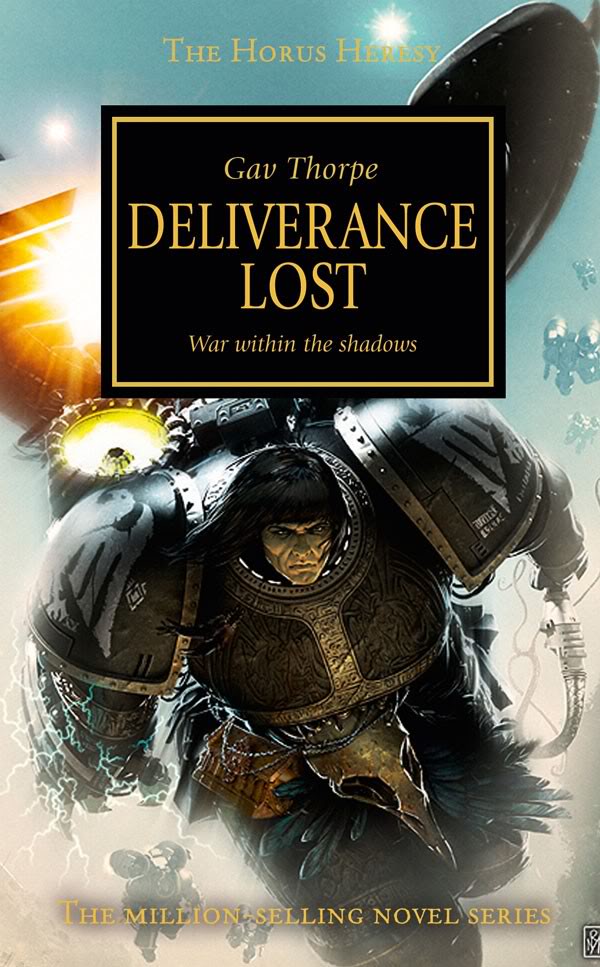

It's in their subject matter, rather than the quality of the work involved, that they serve as good examples of the Horus Heresy series' current charm; namely, it's versatility. In the early days of the series it ran the risk of, and often succumbed to, repetition; so many novels, by so many authors, all recounting this Space Marine battle or that one, but the wider ramifications of the great betrayal at the heart of the series, and the intricacies of how this Universe actually functioned, were never explored; or  if they were it was in a perfunctory manner designed to give you just enough information to herd you to the next gunfight. 

Of late, things have changed.

We'd had hints of a new direction for a while; notably, but not exclusively, in the 13th book, Nemesis. It was with book 16 though; novella collection Age of Darkness; that they fully embarked on their new direction. These two books embrace that change wholeheartedly, with TOD dealing with events among the 'little people' on Earth for the first time, and DL, while it does deal with Space Marines and has a couple of battles, has as it's main focus a story of obsession, genetic engineering and espionage. As I said above, neither book is entirely successful and DL falls apart completely at the end but it's pleasing to see these new avenues being explored, and new story telling roads being traveled. 

I'm not suggesting for one second that Space Marine battles should be excised completely from the series; it's entirely based on a tabletop game involving Space Marines shooting each other; but it's nice that they're acknowledging that they have created, perhaps by accident, a Universe ripe for exploration. Some very good writers ply their trade in the Warhammer/Warhammer 40,000 tie-in range; as well as some very bad ones of course; and it should be interesting to see what they come up with now that they're free to spread their wings. Mistakes will be made, like Deliverance Lost, but when they find their rhythm I predict some excellent space opera could be forthcoming. Can't wait.

Friday, 17 June 2011

Horus Heresy : Nemesis


When last I spoke on here about the Horus Heresy series it was regarding the novel Mechanicum by Graham MacNeill. I spoke of liking the novel because it focused far more on the character interactions and much less on the technological aspects of the story. When the book which followed Mechanicum, Tales Of Heresy, turned out to be a collection of short stories rather than a novel I was buoyed by the fact that several of said stories moved even further down that trail, exploring the wider world that the series is set in and giving us a couple of lively and engrossing character pieces that had no need of genetically engineered supermen laying waste to entire worlds to generate drama. I inferred from their inclusion that the series as a whole might be in the process of widening its horizons somewhat, which pleased me.

Don't get me wrong; I've nothing against a bit of the old uber-violence now and again and after all, this is a series about a massive galaxy wide civil war set millenia in the future so there was always going to be a bit of tech and bravado involved; but I do think that a little bit of variety would stand the series in good stead. I mentioned at the time to a colleague of mine that perhaps a novel set in the shady political corridors of power might be a good idea, or an espionage novel set in this world. There had to be spies, right? In a war that big of course they were there. Sadly, what we got instead was two more novels about Space Marines blowing up aliens and then having a go at each other with their big guns and massive ships. Business as usual. Good stuff, but nothing especially original.So imagine my surprise then when we got Nemesis, by James Swallow as the 13th book in the series.

Almost completely eschewing the world of the Astartes (Space Marines), apart from brief moments in the prologue and epilogues and a brief but bloody and shocking cameo at the mid way point for an Astartes we'd seen before in the books, Nemesis focuses on the shadowy world of political assassination, with both sides despatching agents to assassinate the figurehead of the other. Leaving aside the fact that we know both sides will fail, because the series is a long way from over, the change of focus works well, allowing for a much more intimate look at the characters.

For much of the first half of the book we follow two stories; first, the formation of the team sent by the Loyalists to assassinate rebel leader Horus and then the events that unfold when they actually go out on the mission; and second, the story of a policeman on an Imperial world, investigating a series of ritualistic murders while his world suffers under the weight of rumours concerning the imminent arrival of Horus' rebel forces. As the story progresses into the back half, though, this strand takes a very dark - or darker - turn, and we realise that with this storyline nothing is what it seems.

I'm not massively versed in the futuristic Warhammer universe - the Horus Heresy books being my only foray into it so far - so it's likely that I'm not doing a very good job of describing why this book is so different from what has come before, or why I'm so pleased that it is, despite having enjoyed those earlier stories, but it is and I am. I sincerely hope that the wait for James Swallow to contribute another book to this series is not as long as the last one (he previously supplied Book 4), because he has proved himself here to be an author who can absolutely nail what I want more of in these books.

Friday, 15 October 2010

Horus Heresy : Mechanicum


Warhammer, the sword and sorcery tabletop miniature game and it's far future equivalent Warhammer 40000 hold little to no appeal for me. I have nothing against them, or the people who play them, but they just aren't my cup of tea. However, for the last couple of years I have been getting really rather hooked on the range of novels that are set in and around the world of the games.

My first encounter didn't go well. The Blackguards by Nathan Long. Not recommended. At all. After that though, I decided a second chance was in order so I went with the Horus Heresy series. The Horus Heresy is actually set 10000 years before the Warhammer 40000 game/novels. It purports to tell the tale of how the pretty bloody shitty, universe in chaos, perpetual civil war, demons running rampant state of affairs in Warhammer 40000 came about, by chronicling the events surrounding Horus Lupercal, Warmaster and right hand man to the beloved Emperor, as he is corrupted by evil and leads a bloody revolt against the Emperor.

I have read a number of these books now and I have to say that it is a strange series to get your head around, at least at first. A number of authors work on the series and while there is a definite 'house style' if you like, you can still see the influences that the different writers bring to the table, so the books all read slightly differently. I read the first three, which were a fairly tightly plotted trilogy, back to back and it definitely felt jarring as I went from one book to another. After that initial trilogy another thing occurred that threw one a little at first. The books began to shift around. Some would propel the story forward, some would backtrack yet further and some would show us events we'd already seen but through the eyes of a different set of characters. The series is as non linear as you're likely to get and yet the sense is definitely there of a plan, a framework that everyone is working to. Once I grasped what was happening (and I'm not so dense that it took me that long) I really embraced the method.

So anyway, Mechanicum is the title of the latest Horus Heresy book I've read and it concerns the titular organization being courted by Horus to join his rebellion. The Mechanicum are, as their name suggests, the technical wizards of this future setting, who have elevated machinery to the level of a religion. They are not in fact one organization but rather a loose alliance of separate 'Forges'; essentially factions that argue and compete amongst themselves but are united in their worship of machinery. Their main function in the story is to provide weapons and ships to the Emperors Great Crusade (he wants to wipe out all alien life and claim the universe for Man basically) and Horus wants them onside so that when the rebellion happens he is equipped and the loyalists won't be. Simple really.

Of course, all does not go to plan and the Mechanicum split down the middle, conveniently allowing both sides in the civil war to have weapons and ammo (otherwise it would be a short series). This outcome is inevitable really, for the reason given, so the book needed to have something else to become a truly essential addition to the series. Whether it has that something is, to be honest, debatable. An aspect I've seen talked about elsewhere is that it is the first in the series not to focus on people or groups actively involved in the Great Crusade. While this is true, I'll be honest with you here and say that a lot of the people we follow in this book, in terms of motivations, character traits and lifestyles are pretty much indistinguishable from the Space Marines et cetera that we've seen in previous books. We are told that they are allies of the Emperor, rather than being under his command, but you'd never know it from the way they live. So for a long time player of the games I imagine this book would be simply a necessary building block in the series, setting the pieces on the board where they need to be for future developments but not necessarily particularly thrilling in it's own right.

For me personally, however, Mechanicum scores very highly in a way that it probably doesn't for these long time fans. And it's for a reason that is going to sound a little strange, given the title and setting of the book. One of my main beefs with the series has always been the over reliance on tech porn. That is, the long, lingering explanations of every piece of weaponry, every inch of battle armour, every rivet and plate on the ships. For those who came to the books from the games, this obsession with tech is probably a big part of the attraction, seeing as how a large part of their hobby is in the construction of incredibly elaborate models of these very ships and bits of kit. For me though, who came for story, they can be laborious and really pull me out of the story. This is not something I can complain about; the gamers are, after all, the primary market for these books and I am the outsider.

Mechanicum is different though. It is the first book in the series to really be about characters over technology and the first book where the smaller characters (characters like Horus and his contemporaries have always been well drawn) have felt like anything other than pawns. It's odd, I know, that a book about technical geniuses who worship machinery should be the book least reliant on technology in it's story but somehow that is what we have here and to my mind, it is much the better for it. Graham McNeill, kudos.