It's been a little while since I posted on here but apparently; or at least so
twitter tells me; it's National Book Lovers Day, so I thought, why not bash
something out? For the larks, as it were. And for better or worse, I actually
followed through. So here you are...
Reading has been my thing for as far
back as I can recall. I taught myself to read at a tender age simply to have
something to do in the 'children should be seen and not heard and not even that
if we can manage it' atmosphere of neglect I grew up in, so by the time I was
at school I was a bit of a headache for my teachers who didn't really know what
to do with me while they were teaching the other kids to do what was already
second nature to me. So they complained to my parents then made me do the
lessons anyway.
Being forced to sit in class and recite The Cat On The Mat and Spot Has A Ball
and other suchlikes couldn't derail what had by the age of 8 or 9 become
essentially my only source of pleasure. But it certainly didn't help. The
person who did help, was my Year 6 teacher, who did me the solid of excluding
me from reading circle and giving me a copy of Call Of The Wild to pass the
time. The man had his faults, but I'll love him until I die for that.
Pretty much the only time I ever truly found my love of books waning was during
my Secondary education and it was English Lit class that did it.
I could live with being told I had to read something. I could even live with
the fact that 90% of what I was being told I had to read was antiquated garbage
in which I and my classmates had zero interest and which was only on the
curriculum because it had always been on the curriculum and the people who made
the decisions about that kind of thing were terrified of accusations of dumbing
down if they removed it.
The problems started with the dictated pace. Read chapters 2 and 3 they'd say.
But what if chapter 3 ended on a really exciting bit and you wanted to know
what happened next? Nope, stop at the end of chapter 3, thank you very much.
That problem was easily solved of course by simply ignoring it. On the rare
occasions that we were given a book that actually got it's hooks into me, I'd
have the whole thing read by the second lesson and damn the consequences. To
Kill A Mockingbird, I'm looking at you. A problem less easy to solve was what
came next. The analysis. AKA, talking about the book.
I could write an essay just fine, but I begrudged it. I've always hated the
'what was the author trying to say here?' and 'what are the thematical themey
themes in this relationship?' discussion points, because they always come with
that nagging underlying implication that there are correct answers and I'm of
the school of thought that says that what the book is about is whatever you
think it's about, authorial intent be damned. I mean, why would you want to
tell someone that a book which had made them feel something had made them feel
the wrong something and they should read this paragraph again and DO YOU SEE
NOW? But maybe that's just me.
Anyway, I could write essays passingly well. What made me dread the thought of
opening a book was the dreaded, but inevitable GROUP DISCUSSION and the equally
inevitable and even more dreaded FUN LITTLE ROLE PLAY EXERCISE. For someone as
introverted and, let's face it, pathologically shy as myself those classes were
absolute mental torture. I wouldn't sleep the night before, I'd have panic
attacks in the toilets before the bell... it was all I could do to quell tears
on more than one occasion. So yes, English Lit. was a killer for me.
But then I quit full time education and got a full time menial job that I'm
still stuck in to this day so jokes on you Teacher Who Made Me Pretend To be
Eric Birling And Answer Questions From The Class About A Girl I Knew Once.
It took a little while, but once I got over the fear of someone pouncing
on me on the bus screaming about the homosexual subtext in Patriot Games or the
obvious Vietnam War parallels in The Naughtiest Girl In The School, I dared to
read again. And I've never stopped.
So, with that incredibly long brief introduction to me and my relationship with
books, let's get on to what I came here for. To tell you my favourites! Except these aren't my favourites so much as the ones I've been thinking about lately that I really like. Ask me again in a week and I'd probably knock up a totally different list. Apart from the first one. Obviously.
So in the
unlikely event that anyone values my opinion about this stuff;I'm under no
illusions; here goes...
The Borribles - Michael de Larrabeiti
Well duh. Anyone who knows me at all will tell you that The Borribles is, in my
opinion, one of the greatest works of YA; although it wasn't called that at the
time; ever written. Beautifully drawn characters that you love from the moment
you meet them, thrilling adventure stories with some very, very, dark
undertones and a pair of grotesques as the series villains that wouldn't have
looked out of place on the streets of Royston Vasey. Oh, and the ending will
break your heart.
The Naughtiest Girl In The School - Enid Blyton
AKA, Hey Everyone, Isn't Communism Smashing?
I can't help it, I loved this book when I first read it and the heroine became my heroine instantly. Of course she
realises the error of her ways and conforms by the end of the book because what
else was going to happen in a book about adolescent rebellion in the 1940's,
but while it lasted her efforts to rail against what she saw as an unjust
system; and she wasn't wrong damn it; had me cheering her on with a song in my
heart.
I never read the sequels. I couldn't bear to see her brought any lower.
Their Masters War - Mick Farren
A society of 'primitives' make a pilgrimage to sacrifice some of their own to
their Gods. The Gods turn out to be recruiting said sacrifices for an
intergalactic war. Cue all guns blazing military space opera. With semi
sentient symbiotic living uniforms that could, if you asked really nicely, be
persuaded to give you an orgasm. Heady stuff for a 10 year old. No idea if it's
actually any good but I loved it as a kid. And not just for the trousers that
could perform fellatio. I barely knew what fellatio was. Even now it's
something of an abstract concept.
2000AD - Various
Not strictly speaking a book but the first comic I ever read regularly and the
last man standing in the grim war of attrition that was the British Comic
Industry of the 20th century.There are some whippersnappers on the shelves
today, but 2000AD is the proud veteran, still showing the new recruits how
it's done.
2000AD has been in (almost) continuous weekly publication for close to
40 years at this point so it has quite the back catalogue. Luckily it's
current publisher has a quite frankly superb line of graphic novels
collecting pretty much everything so there's something for everyone out
there.
AND that's your whack. I mean I could
go on; The 5th Wave and it's sequels are apocalyptic YA sci-fi to die
for with one of my favourite heroines in years; I'm a few books behind
in my reading of Zoe Marriot's back catalogue but she's getting better
by the book (and her debut was no slouch); Diana Gabaldon is in dire
need of an editor and her sexual politics are a bit iffy but aside from
that she writes rollicking good historical adventure stories; Robert
Rankin and his Far Fetched Fiction never fails to make me positively
guffaw, to the point that I now refuse to read him in public...you get
the idea. Better to stop now or I'll still be typing this time next
National Book Lovers Day.
Tuesday, 9 August 2016

Tuesday, 18 February 2014
Cross Stitch (Outlander)
The majority of my, sadly much reduced, reading of late has comprised me
desperately trying to stay ahead of the seemingly endless adaptations that
movie and TV companies are apparently never going to get tired of throwing at
us. Most of these; Jonathan Strange & Mr Norrell, Divergent, The 100; and
Bitten, which is next on the list, are books I would have read eventually
anyway but the one I just finished was never even on my radar until Starz
announced that they were adapting it. I speak of course, of Outlander.

Outlander, or Cross-Stitch as the UK edition is called; I was quite cross about this for a while, until I found out that Cross-Stitch was actually the authors original and preferred title so it's the Americans who should be annoyed, thank you wikipedia; is an odd beast. I liked it, don't get me wrong, but I wanted to love it and that just never really happened. It came close a couple of times, but never quite gelled properly for me.
Stripped to it's barest bones, the plot is nothing fiercely original; a time traveler becomes trapped in an era alien to their sensibilities, and must adapt to survive. In this case Claire Randall, a battlefield nurse fresh from the wars, is whisked back in time to Scotland on the eve of the Jacobite uprising; as well as dealing with the rising tensions between the English and their Scottish subjects, she must also tread lightly for fear of her modern attitudes, and indeed her modern medicine, getting her the kind of reputation you really don't want in a still massively superstitious culture.
And that right there, is a plot I want to read. Unfortunately, it's a plot that goes off the rails once the inevitable love story comes into play.
Finding herself thrust into a marriage of political expediency Claire, in a shocking twist (which is so inevitable as to be revealed on the cover as part of the premise, despite not happening until a good few hundred pages into the book), falls in love with the man in question. Which is all well and good; except it isn't.
I'm not going to get up in arms about how she's already married and is therefore an adulteress, and a bigamist (maybe not technically; there's some admirably energetic doublespeak employed to explain why she isn't at all, no way, don't be silly. But, you know, she's married and she gets married again); which seems to be a major bugbear for some people, but I am going to have a problem with a couple of things.
Firstly, the much vaunted epic love between the two is completely absent in the first half of the book, when she is still looking for a way home and isn't looking at him romantically, before suddenly being shoved down our throats in as engineered and contrived a manner as I've ever read. She loves him because the author says she loves him, and the author says she loves him because, well, that's just what happens in stories like this. I think that if their relationship had continued in the 'grudging respect leading to deep friendship' vein of the early chapters, the book would have been the better for it.
Secondly, and I don't mean to be blunt, he beats her. It's presented in a matter of fact, 'that's just how they did things back then' light, and maybe it was, and maybe it would have been unrealistic to shy away from that, but the fact remains that while it may be the way they did things back then, it most certainly isn't how they do it where she comes from, and it's a betrayal of her character that she accepts it so readily. Yes, she protests, and yes, she makes token threats of what she'll do if he ever tries it again, but she is at his mercy, and he beats her, and she not only forgives him but their 'love' affair steamrolls from that point on. This is not a healthy relationship.
To be clear, I'm not talking about the controversial rough sex sections, which seem to cause as much consternation as the infidelity in some quarters; the record (and my google history) will attest that I have no problems whatsoever with that kind of thing between consenting adults, but the cold blooded, methodical, corporal punishment of a man who feels the need to control his wife... that left a bitter taste.
Moving away from the central relationship, we come to another problem, again on a sexual theme; homosexuality. There are two prominent homosexual characters in the novel, and while one of them is presented as an amiable and likable man who wins over Claire with his charm and wit, he's also a man with a long history of being predatory towards young boys lower in social standing and power; a 'kink' that is treated as a running gag. And the other is a sexual sadist who may or may not have molested his brother when they were kids. I'm not saying the prejudice is intentional, but it's problematic, regardless.
Then there are the plots that go nowhere, such as the Nessie style monster and the second time traveler. Both are presented as being a big deal; both fizzle out well before the climax. Hell, even Claire's efforts to get home are abandoned halfway through the book and her poor first husband all but forgotten about. In fact, I'm doubtful you could even say the book has a climax; it more just sort of dawdles along to a vague happy ending with the leads having run away and ignored their problems.
Now, maybe this stuff will be dealt with in the sequels, I don't know, but the fact is that this book wasn't written as the first in a series, and wasn't sold as such. As a standalone novel, it's a bit of a hot mess.
But, lest we forget, I did say that I liked, if not loved it. Why? Well, the aforementioned friendship between the leads was very well crafted before it devolved into the very dodgy sexual politics of their married life; the depiction of life in Scotland under the yolk of the English is evocative (if a little on the nose) and the political intrigue of the Clan power machinations is gripping stuff, even if it does fizzle out with the rest of the decent plots a hundred pages before the end.
Gabaldon is a good writer. Her prose is dense, but never so much so as to confuse or bore, and her characters, when they behave like human beings and not robots servicing a plot, are well drawn and for the most part likable. Let's just hope the sequels; which I will be reading; have a tighter focus, and a surer handle on their characters.
Outlander, or Cross-Stitch as the UK edition is called; I was quite cross about this for a while, until I found out that Cross-Stitch was actually the authors original and preferred title so it's the Americans who should be annoyed, thank you wikipedia; is an odd beast. I liked it, don't get me wrong, but I wanted to love it and that just never really happened. It came close a couple of times, but never quite gelled properly for me.
Stripped to it's barest bones, the plot is nothing fiercely original; a time traveler becomes trapped in an era alien to their sensibilities, and must adapt to survive. In this case Claire Randall, a battlefield nurse fresh from the wars, is whisked back in time to Scotland on the eve of the Jacobite uprising; as well as dealing with the rising tensions between the English and their Scottish subjects, she must also tread lightly for fear of her modern attitudes, and indeed her modern medicine, getting her the kind of reputation you really don't want in a still massively superstitious culture.
And that right there, is a plot I want to read. Unfortunately, it's a plot that goes off the rails once the inevitable love story comes into play.
Finding herself thrust into a marriage of political expediency Claire, in a shocking twist (which is so inevitable as to be revealed on the cover as part of the premise, despite not happening until a good few hundred pages into the book), falls in love with the man in question. Which is all well and good; except it isn't.
I'm not going to get up in arms about how she's already married and is therefore an adulteress, and a bigamist (maybe not technically; there's some admirably energetic doublespeak employed to explain why she isn't at all, no way, don't be silly. But, you know, she's married and she gets married again); which seems to be a major bugbear for some people, but I am going to have a problem with a couple of things.
Firstly, the much vaunted epic love between the two is completely absent in the first half of the book, when she is still looking for a way home and isn't looking at him romantically, before suddenly being shoved down our throats in as engineered and contrived a manner as I've ever read. She loves him because the author says she loves him, and the author says she loves him because, well, that's just what happens in stories like this. I think that if their relationship had continued in the 'grudging respect leading to deep friendship' vein of the early chapters, the book would have been the better for it.
Secondly, and I don't mean to be blunt, he beats her. It's presented in a matter of fact, 'that's just how they did things back then' light, and maybe it was, and maybe it would have been unrealistic to shy away from that, but the fact remains that while it may be the way they did things back then, it most certainly isn't how they do it where she comes from, and it's a betrayal of her character that she accepts it so readily. Yes, she protests, and yes, she makes token threats of what she'll do if he ever tries it again, but she is at his mercy, and he beats her, and she not only forgives him but their 'love' affair steamrolls from that point on. This is not a healthy relationship.
To be clear, I'm not talking about the controversial rough sex sections, which seem to cause as much consternation as the infidelity in some quarters; the record (and my google history) will attest that I have no problems whatsoever with that kind of thing between consenting adults, but the cold blooded, methodical, corporal punishment of a man who feels the need to control his wife... that left a bitter taste.
Moving away from the central relationship, we come to another problem, again on a sexual theme; homosexuality. There are two prominent homosexual characters in the novel, and while one of them is presented as an amiable and likable man who wins over Claire with his charm and wit, he's also a man with a long history of being predatory towards young boys lower in social standing and power; a 'kink' that is treated as a running gag. And the other is a sexual sadist who may or may not have molested his brother when they were kids. I'm not saying the prejudice is intentional, but it's problematic, regardless.
Then there are the plots that go nowhere, such as the Nessie style monster and the second time traveler. Both are presented as being a big deal; both fizzle out well before the climax. Hell, even Claire's efforts to get home are abandoned halfway through the book and her poor first husband all but forgotten about. In fact, I'm doubtful you could even say the book has a climax; it more just sort of dawdles along to a vague happy ending with the leads having run away and ignored their problems.
Now, maybe this stuff will be dealt with in the sequels, I don't know, but the fact is that this book wasn't written as the first in a series, and wasn't sold as such. As a standalone novel, it's a bit of a hot mess.
But, lest we forget, I did say that I liked, if not loved it. Why? Well, the aforementioned friendship between the leads was very well crafted before it devolved into the very dodgy sexual politics of their married life; the depiction of life in Scotland under the yolk of the English is evocative (if a little on the nose) and the political intrigue of the Clan power machinations is gripping stuff, even if it does fizzle out with the rest of the decent plots a hundred pages before the end.
Gabaldon is a good writer. Her prose is dense, but never so much so as to confuse or bore, and her characters, when they behave like human beings and not robots servicing a plot, are well drawn and for the most part likable. Let's just hope the sequels; which I will be reading; have a tighter focus, and a surer handle on their characters.
 |
| Diana Gabaldon |
Saturday, 8 February 2014
In Her Bones
Hello all. It's been a while. A long while. Fecking ages, in fact.
Sorry about that.
I haven't been totally idle on here though, oh no! I've changed the title of the blog. Of course, what that means is that the url changed too, which means that the genre tabs at the top of the page there all lead to dead links. Didn't think that through, did I? As of typing this I actually noticed that little problem a few days ago, but, you know...lazy. So it's not fixed yet. Again, sorry.
Anyway, to the business at hand. My first foray into reading self e-published material. I didn't know what kind of standard to expect but I was pleasantly surprised. So here you are, In Her Bones, by Natasha Kingston; the first in the Bearing Gifts series.

There's not a lot of plot to be had in this book, but you can forgive that because as the first in what I'm given to believe is to be a long series of novella length releases this title is concerning itself, as a beginning should, way more with character. Because no-one cares what is happening if they don't care about the person it's happening too, right?
Oh, there are hints here and there, and intriguing ones at that, as to a wider world waiting in the wings to unfold for us; and a stonking little cliffhanger that should bring you back for number two; but what this book really does is introduce us to, and immerse us in the life of, our heroine.
And she's a doozy. Violet Munoz is the kind of young woman who should be an inspiration to us all; she's hot and she knows it, she enjoys sex for the pure joy of sex, and she has multiple casual relationships going on at the same time, whilst, and this is the important part, making no apologies for any of it. She's unsure where her life is going to take her, but she's living it on her terms and having fun in the process, and in doing so she makes us like her, flaws and all, pretty much from the moment we start reading her story; I mean who can resist that level of infectious enthusiasm for life?
Violets friends and colleagues are sketched out a little less intricately, but I've a feeling that's by design; we'll learn more about them as the story progressses and their place in the in the grand scheme of things becomes clear, I'm sure. There's one in particular I have my eye on...
Of course, Violets carefree existence can't be allowed to last for long, because that would not a good story make, and as I mentioned above we get plenty of hints of future complications for her; just what are those cold flashes? And what is this compulsion she has to get closer to someone she's really just not that into?; but for now, it's simple; I love Violet, and I want to read more of her story. So, job done.
In the interests of full disclosure, I should probably point out that I am a huge fan of Natasha Kingston's previous creative endeavour (no not her pornographic short stories, although yes, those too, shut up), the rather wonderful Unspoiled podcast, which she hosts and produces with her husband Brendan (upon whom I have a pretty massive man crush; again, shut up) so, you know...
This in no way invalidates my assertion that In Her Bones is good. No it doesn't. NO IT... How many times do I have to tell you to shut up?
Sorry about that.
I haven't been totally idle on here though, oh no! I've changed the title of the blog. Of course, what that means is that the url changed too, which means that the genre tabs at the top of the page there all lead to dead links. Didn't think that through, did I? As of typing this I actually noticed that little problem a few days ago, but, you know...lazy. So it's not fixed yet. Again, sorry.
Anyway, to the business at hand. My first foray into reading self e-published material. I didn't know what kind of standard to expect but I was pleasantly surprised. So here you are, In Her Bones, by Natasha Kingston; the first in the Bearing Gifts series.
There's not a lot of plot to be had in this book, but you can forgive that because as the first in what I'm given to believe is to be a long series of novella length releases this title is concerning itself, as a beginning should, way more with character. Because no-one cares what is happening if they don't care about the person it's happening too, right?
Oh, there are hints here and there, and intriguing ones at that, as to a wider world waiting in the wings to unfold for us; and a stonking little cliffhanger that should bring you back for number two; but what this book really does is introduce us to, and immerse us in the life of, our heroine.
And she's a doozy. Violet Munoz is the kind of young woman who should be an inspiration to us all; she's hot and she knows it, she enjoys sex for the pure joy of sex, and she has multiple casual relationships going on at the same time, whilst, and this is the important part, making no apologies for any of it. She's unsure where her life is going to take her, but she's living it on her terms and having fun in the process, and in doing so she makes us like her, flaws and all, pretty much from the moment we start reading her story; I mean who can resist that level of infectious enthusiasm for life?
Violets friends and colleagues are sketched out a little less intricately, but I've a feeling that's by design; we'll learn more about them as the story progressses and their place in the in the grand scheme of things becomes clear, I'm sure. There's one in particular I have my eye on...
Of course, Violets carefree existence can't be allowed to last for long, because that would not a good story make, and as I mentioned above we get plenty of hints of future complications for her; just what are those cold flashes? And what is this compulsion she has to get closer to someone she's really just not that into?; but for now, it's simple; I love Violet, and I want to read more of her story. So, job done.
 |
| Natasha Kingston |
This in no way invalidates my assertion that In Her Bones is good. No it doesn't. NO IT... How many times do I have to tell you to shut up?
Friday, 11 January 2013
Catching Fire
Christmas eh? And New Years? Who'd have em? Exactly. And so on and so forth. You get the drift.
Anyway, first post on here of 2013! I ummed and aahed as to what to do but in the end there was one choice really; I would delve back into my frantic attempts to catch up with what everyone else read two years ago. So without further ado, I give you...

Katniss Everdeen survived the Hunger Games but in order to ensure that friend and potential love interest Peeta did too she had to embarrass the organisers, and by extension the administration of creepy old President Snow; an act which has made her an unwitting, and indeed unwilling, symbol of hope for a burgeoning resistance movement. All Katniss wants to do is be left alone, but let's face it; she's the lead in a trilogy, and is only one book in. She's not getting an easy life any time soon; that's just science.
Sure enough, President Snow comes up with a way to strike back at her for her
impertinence (and keep the series going); he re-jigs the entire concept of the
Hunger Games to get past winners back in the arena, and since Katniss' native
District 12 doesn't have that many to choose from, it's back to the Capital she
goes.
Catching Fire isn't really about the games themselves though. The Hunger Games took a while to get Katniss and Peeta into the arena, yes, but the main thrust of the plot was the games; here we have to wait even longer before the games start, and when they do it's clear from the off that something isn't quite right with them.
There is a much greater amount of time spent establishing the other entrants in the games this time around; presumably because they are going to be important later, as opposed to the first book's glorified cannon fodder; but Collins does it with a sure hand, never once allowing them to distract her too much from the job at hand. That being, making Katniss annoying.
And that, right there, is the rub of the nub. Sorry fans, but as much I enjoyed this book there is no getting away from the fact that Collins has fallen prey to the same pitfall that so many others before her have fallen into; namely, having a first person narrator who is the least interesting, and most annoying, character in the story. And I say this as someone who praised the Katniss character in my post on the first book.
For some reason all of her 'quirks' and the little annoyances that I forgave the first time around just seemed amplified in this book and made it harder and harder to like the girl. Maybe I'm being dense; maybe the point is that we aren't supposed to like her. In which case, well done, mission accomplished.
Plotwise, however, the book is fantastic. It takes what could have been a carbon copy of the original and turns it on it's head, while the finale; uber exciting action set piece that it is; sends the characters, and the entire series, off in a totally new direction that there is no coming back from. Mockingjay is going to be something else.
Catching Fire isn't really about the games themselves though. The Hunger Games took a while to get Katniss and Peeta into the arena, yes, but the main thrust of the plot was the games; here we have to wait even longer before the games start, and when they do it's clear from the off that something isn't quite right with them.
There is a much greater amount of time spent establishing the other entrants in the games this time around; presumably because they are going to be important later, as opposed to the first book's glorified cannon fodder; but Collins does it with a sure hand, never once allowing them to distract her too much from the job at hand. That being, making Katniss annoying.
And that, right there, is the rub of the nub. Sorry fans, but as much I enjoyed this book there is no getting away from the fact that Collins has fallen prey to the same pitfall that so many others before her have fallen into; namely, having a first person narrator who is the least interesting, and most annoying, character in the story. And I say this as someone who praised the Katniss character in my post on the first book.
For some reason all of her 'quirks' and the little annoyances that I forgave the first time around just seemed amplified in this book and made it harder and harder to like the girl. Maybe I'm being dense; maybe the point is that we aren't supposed to like her. In which case, well done, mission accomplished.
Plotwise, however, the book is fantastic. It takes what could have been a carbon copy of the original and turns it on it's head, while the finale; uber exciting action set piece that it is; sends the characters, and the entire series, off in a totally new direction that there is no coming back from. Mockingjay is going to be something else.
 |
| Suzanne Collins |
And that was my, somewhat less than any good at all post on Catching Fire. I really did enjoy it. A lot. Honest.
Next week will see the blog play host to a collection of comics featuring everyone's favourite immortal mystic, Madame Xanadu. See ya later.
Next week will see the blog play host to a collection of comics featuring everyone's favourite immortal mystic, Madame Xanadu. See ya later.
Wednesday, 12 December 2012
Into The Woods
In this post I shall discuss one of the many titles I bought at CCC, but UNLIKE last year, I'll do it before a month and a half has passed and everyone else has moved on. Never let it be said that I don't learn from my mistakes. Sometimes.
This years pick of the haul; meaning no disrespect to anything else I picked up but I read this first; is Into The Woods: A Fairytale Anthology (ed. Stacey Whittle). This book has actually been out a good while and I had intended to pick it up last year but one thing led to another and life got in the way. I figured, though, that if I went to an event organised in large part by the books editor and still didn't pick up a copy then I had no one to blame but myself. So I did, and I'm glad I did.

First thing you notice about Into The Woods is that it's a very handsome package; card cover (adorned with some rather lovely artwork by the team of Andy Bloor and Steve Howard) with a proper spine and everything, wrapped around good quality glossy paper throughout, which really allows the artwork of the various contributors to look it's best.
With 9 short stories across 46 pages of comic; all from different creative teams and between them spanning as wide a spectrum of styles and tones as the Fairy Tale remit will allow; I would imagine that there is something for pretty much everybody here, with nothing outstaying it's welcome either. In fact, if anything I'd say that a couple of these stories end slightly abruptly; if never unsatisfactorily.
Personal highlights for me were A Time For A Change (Ollie Masters and Valia Kapadai) which sees the deities of old coming to terms with their obsolescence in our age of reason; Changeling (Alexi Conman and Conor Boyle) which is just depressing as hell, in the best possible way (and has a killer panel on page 3 that made me laugh out loud; buy the book and guess which one I mean); and Samhain (Mathew Gibbs and Alice Duke), concerning the consequences for two young lads when they try to cover up a fatal hit and run.
I must confess that I didn't enjoy Samhain quite so much on first reading, and I blamed Duke's art for not doing enough to differentiate between the two protagonists, which made the whole thing confusing. Then I read it again and realised that they were wearing completely different outfits, so... and I wasn't even drunk.
The book is rounded off with an afterword from editor Stacey Whittle which is a trifle gushing; she is a girl after all; but obviously sincere and full of an infectious enthusiasm that makes you cross your fingers that this first excursion into the field will not be her last. Roll on volume two I say.
Just in case there's any doubt, I would absolutely recommend this book to anyone; comics fan, lover of fairy tales or just someone who appreciates a good story. You really can't go wrong.
In the event that I've moved you to want to buy this book, you can do so here. Go on, you'll thank me later.
If you do buy a copy though, I'd advise against visiting the editors blog, whittlewaffle, which is pimped on the back cover; a back cover which also has a beautiful piece of art on it, this time by Vicky Stonebridge, just to round out the package in style; because I've been a follower of said blog for some time and it's all...pink and...girly and...full of posts about Strictly Come Dancing. *shudder* You have been warned.
Sunday, 9 December 2012
House of Mystery: Love Stories For Dead People
Comics! With the pictures and the words and the coming together of the pictures
and the words to make the stories happen! Yeah, you know what I'm talking about!

This week, we delve once more into the mysteries surrounding The House of, well, Mystery, funnily enough, to see how new resident Fig is doing, after finding herself trapped there in the first book.
It turns out, she's been moping, with occasional breaks to throw tantrums. Can't blame her though, it must have been an adjustment.
As you might expect from book 2 of a series, this is very much a bedding in tale. Having established the premise in the first book; certain lost souls end up trapped in the House of Mystery, serving bar and waiting tables for the clientele who are free to come and go at will; the writers now set out to give us an idea of who some of these characters are, beyond the archetypes they seemed to embody when we first met them.
So, we get a tale of The Pirate, Anne, and how she fell in love with a man who betrayed her, with violent consequences; or The Bartender, Harry, who's been in the house longer than any of them, and had adventures they wouldn't believe with some of the powers and forces behind the House's origins (and who sometimes hears the house talking to him, which is perfectly normal, thank you very much).
and of course The
Drama Queen, who believes herself to be under a curse, with the story
she tells to prove it having some inspired guest characters.
Writers Bill Willingham and Matthew Sturges aren't new to this game though, and for every tidbit of information they give us, they leave twice as many mysteries still to be revealed. They're also well aware that a series of flashbacks and character monologues; however creepy, violent, intriguing, or combination of all three they may be; do not a narrative make and they tie the whole thing together with a good old fashioned quest, as three of our leads head off on an ill fated escape attempt, into the tunnels in the basement.
This escape, which spans the five issues collected in this book, isn't just a shoehorned in attempt to convince us there is a plot though.
No, it leads slowly and surely to a revelation, to a tragedy, and in
the final instance to the introduction of a new character that will be
sure to send the series in some very interesting new directions.
What it doesn't lead to (spoiler alert) is anyone getting out. The three intrepid adventurers are right back where they started at the end of the book, along with their new 'friend', but that's ok; this series has a long way to go yet, and they need to be there to play their parts; the time for happy endings will be later.
Maybe.

This week, we delve once more into the mysteries surrounding The House of, well, Mystery, funnily enough, to see how new resident Fig is doing, after finding herself trapped there in the first book.
It turns out, she's been moping, with occasional breaks to throw tantrums. Can't blame her though, it must have been an adjustment.
As you might expect from book 2 of a series, this is very much a bedding in tale. Having established the premise in the first book; certain lost souls end up trapped in the House of Mystery, serving bar and waiting tables for the clientele who are free to come and go at will; the writers now set out to give us an idea of who some of these characters are, beyond the archetypes they seemed to embody when we first met them.
So, we get a tale of The Pirate, Anne, and how she fell in love with a man who betrayed her, with violent consequences; or The Bartender, Harry, who's been in the house longer than any of them, and had adventures they wouldn't believe with some of the powers and forces behind the House's origins (and who sometimes hears the house talking to him, which is perfectly normal, thank you very much).
 |
| Harry meets Abel. Abel is cool. |
Writers Bill Willingham and Matthew Sturges aren't new to this game though, and for every tidbit of information they give us, they leave twice as many mysteries still to be revealed. They're also well aware that a series of flashbacks and character monologues; however creepy, violent, intriguing, or combination of all three they may be; do not a narrative make and they tie the whole thing together with a good old fashioned quest, as three of our leads head off on an ill fated escape attempt, into the tunnels in the basement.
This escape, which spans the five issues collected in this book, isn't just a shoehorned in attempt to convince us there is a plot though.
 |
| The end of the journey. Miranda is *awesome* |
What it doesn't lead to (spoiler alert) is anyone getting out. The three intrepid adventurers are right back where they started at the end of the book, along with their new 'friend', but that's ok; this series has a long way to go yet, and they need to be there to play their parts; the time for happy endings will be later.
Maybe.
Friday, 16 November 2012
The Hunger Games
Another of my 'where the hell did this come
from and how can there be 3 books already and everyone has already read them
and they're making a movie and no-one will shut up about them and I'm going to
be spoiled on everything before I open the first book and oh god whatever, just
give me it I'll read it now' posts this week.
For the record, I hate when I'm forced to let books jump the queue in order to avoid spoilers. I need my incredibly complicated and strict system of what I read when to remain intact if I don't want the universe to implode behind my eyes. So thank you, spoilery people!
Anyway, I've read The Hunger Games.

You all know the plot; young girl volunteers to take part in a fight to the death against a bunch of other youngsters to prevent her little sister from being drafted; she and lots of other kids, some nice, some not, are shipped into an arena and start killing each other; rich folk get their jollies by watching; it's all a propaganda/morale crushing technique used by corrupt government to keep the populace in line. It's not a hard concept to grasp.
Much has been made of the unoriginality of the concept; with most citing Battle Royale as the victim of Suzanne Collins 'plagiarism'; because people haven't been rewriting the Greek myths or Shakespeare's plays for centuries, have they?
I once read an interview; and I can't remember where it was, sorry; with Terry Pratchett. He was being asked about a certain big hotshot new author who was making a killing with a bunch of stories based around a school for magically inclined people. Unseen University, anyone? Perhaps the interviewer was hoping, though they never came out and said it, that they would get a bitter rant about ideas theft. If they were expecting that, they were disappointed.
Instead what they got was common sense. He was far from the first to write stories about a school for wizards, and never expected to be the last; when you're working in the fantasy genre, some items are universal, one might even say generic; and what crime had this author committed, other than to get an awful lot of young kids who never would have otherwise to read books? You tell 'em, Tel!
I read an interview recently with Suzanne Collins, where she addressed her inspirations and thought processes behind The Hunger Games. While you'd expect her not to come out and say 'yeah, you got me, I'm a big old hack who nicked her story', the reasoning she did profess was so solid, in-depth and obviously genuine that you'd have to be the most cynical man alive to think she was making shit up to cover her backside. It's churlish and it's mean and it's disrespectful; so stop it.
Rant over. So what did I think of the book itself? Well, I'll tell you.
I loved it. The end.
Ha, that's not really the end. Me needs to waffle.
Katniss Everdeen is an engaging heroine, tis true, even if she is saddled with the tension killer that is a first person narrative; I really don't like them; and it's a good job she is because if you weren't happy in her company you'd find the first half of this book very boring. Not because nothing happens, but rather because nothing that you expect, happens; you go into a book about gladiatorial combat to the death and you expect people to be killing each other, so the fact that it takes almost 200 pages for the contest to begin is bound to be a bit of a drag.
Don't get me wrong, the opening sections do a masterful job establishing this world, and a sense of history, and manage to make the many districts and their respective populations truly distinct; in a way that the movie never quite managed; but it just takes a little too long to do it. I can't help but feel that a happy medium could have been found between the books languid pace and the overly rushed opening of the movie. Never mind.
As a consequence of the first person narrative; I really don't like them; the secondary characters are of course only seen through Katniss' eyes. For characters like Gale and Peeta, the two boys who form the inevitable love triangle with Katniss that all teen novels seem obligated to have, this works; Katniss is confused and unsure about how they feel about her, so the reader needs to be too. Up to a point, of course, because while Katniss may be oblivious to the romantic aspects of life, having grown up worrying more about putting food in her belly than her next kiss, you'd have to be pretty much an idiot to not get where this story is headed. Collins understands this though, and gets around it quite cleverly by giving just enough of a wink that you know she knows you know...er you know what I mean; before long the reader is in on the joke, and is allowed to feel that they're ahead of the character.
The much ballyhoo-ed violence is not, to be fair, as bad as some would have you believe; though still quite nasty in places; but rather it's the emotional shock that packs the weightiest punch. One death in particular, which you know, intellectually, is inevitable, still manages to knock the wind out of your sails when it comes and I will freely admit that I had to put the book down when I read it. Even the (inferior) movie version of the scene got a tear from me, I'm not too proud to admit.
The book stumbles a little in the big finale. If you saw the movie and thought the final bit of peril came out of nowhere and seemed tacked on you'll be pleased to hear that there is a proper explanation for it in the book, and a nasty and chilling one at that, but it still didn't quite work for me, and seemed maybe a step too far into the fantastical. I'm actually glad that the explanation wasn't used in the movie, because I'm not convinced they'd have been able to get it across in a way that made sense.
Slight pacing issues at the start, and a cluttered finale can't detract from what is, without a doubt, a brilliant, tense, thrilling and ultimately moving piece of work by Collins. which had me grasping for the sequel immediately. Highly recommended.
For the record, I hate when I'm forced to let books jump the queue in order to avoid spoilers. I need my incredibly complicated and strict system of what I read when to remain intact if I don't want the universe to implode behind my eyes. So thank you, spoilery people!
Anyway, I've read The Hunger Games.

You all know the plot; young girl volunteers to take part in a fight to the death against a bunch of other youngsters to prevent her little sister from being drafted; she and lots of other kids, some nice, some not, are shipped into an arena and start killing each other; rich folk get their jollies by watching; it's all a propaganda/morale crushing technique used by corrupt government to keep the populace in line. It's not a hard concept to grasp.
Much has been made of the unoriginality of the concept; with most citing Battle Royale as the victim of Suzanne Collins 'plagiarism'; because people haven't been rewriting the Greek myths or Shakespeare's plays for centuries, have they?
I once read an interview; and I can't remember where it was, sorry; with Terry Pratchett. He was being asked about a certain big hotshot new author who was making a killing with a bunch of stories based around a school for magically inclined people. Unseen University, anyone? Perhaps the interviewer was hoping, though they never came out and said it, that they would get a bitter rant about ideas theft. If they were expecting that, they were disappointed.
Instead what they got was common sense. He was far from the first to write stories about a school for wizards, and never expected to be the last; when you're working in the fantasy genre, some items are universal, one might even say generic; and what crime had this author committed, other than to get an awful lot of young kids who never would have otherwise to read books? You tell 'em, Tel!
I read an interview recently with Suzanne Collins, where she addressed her inspirations and thought processes behind The Hunger Games. While you'd expect her not to come out and say 'yeah, you got me, I'm a big old hack who nicked her story', the reasoning she did profess was so solid, in-depth and obviously genuine that you'd have to be the most cynical man alive to think she was making shit up to cover her backside. It's churlish and it's mean and it's disrespectful; so stop it.
Rant over. So what did I think of the book itself? Well, I'll tell you.
I loved it. The end.
Ha, that's not really the end. Me needs to waffle.
Katniss Everdeen is an engaging heroine, tis true, even if she is saddled with the tension killer that is a first person narrative; I really don't like them; and it's a good job she is because if you weren't happy in her company you'd find the first half of this book very boring. Not because nothing happens, but rather because nothing that you expect, happens; you go into a book about gladiatorial combat to the death and you expect people to be killing each other, so the fact that it takes almost 200 pages for the contest to begin is bound to be a bit of a drag.
Don't get me wrong, the opening sections do a masterful job establishing this world, and a sense of history, and manage to make the many districts and their respective populations truly distinct; in a way that the movie never quite managed; but it just takes a little too long to do it. I can't help but feel that a happy medium could have been found between the books languid pace and the overly rushed opening of the movie. Never mind.
As a consequence of the first person narrative; I really don't like them; the secondary characters are of course only seen through Katniss' eyes. For characters like Gale and Peeta, the two boys who form the inevitable love triangle with Katniss that all teen novels seem obligated to have, this works; Katniss is confused and unsure about how they feel about her, so the reader needs to be too. Up to a point, of course, because while Katniss may be oblivious to the romantic aspects of life, having grown up worrying more about putting food in her belly than her next kiss, you'd have to be pretty much an idiot to not get where this story is headed. Collins understands this though, and gets around it quite cleverly by giving just enough of a wink that you know she knows you know...er you know what I mean; before long the reader is in on the joke, and is allowed to feel that they're ahead of the character.
The much ballyhoo-ed violence is not, to be fair, as bad as some would have you believe; though still quite nasty in places; but rather it's the emotional shock that packs the weightiest punch. One death in particular, which you know, intellectually, is inevitable, still manages to knock the wind out of your sails when it comes and I will freely admit that I had to put the book down when I read it. Even the (inferior) movie version of the scene got a tear from me, I'm not too proud to admit.
The book stumbles a little in the big finale. If you saw the movie and thought the final bit of peril came out of nowhere and seemed tacked on you'll be pleased to hear that there is a proper explanation for it in the book, and a nasty and chilling one at that, but it still didn't quite work for me, and seemed maybe a step too far into the fantastical. I'm actually glad that the explanation wasn't used in the movie, because I'm not convinced they'd have been able to get it across in a way that made sense.
Slight pacing issues at the start, and a cluttered finale can't detract from what is, without a doubt, a brilliant, tense, thrilling and ultimately moving piece of work by Collins. which had me grasping for the sequel immediately. Highly recommended.
|
| Suzanne Collins |
Friday, 9 November 2012
The Boys: Get Some

And what an arc it is! I've seen some criticism elsewhere on the internets, even from those who were complimentary about volume one, that this book sputters a little; that having used up all the obvious jokes in book one Ennis struggles to segue into an actual proper plot. I couldn't disagree more.
An investigation into the death of a young man that the police are suspiciously keen to close the file on leads cockney psycho Butcher and fish out of water new boy Hughie to poke their noses into the world of high-tech costumed vigilante Tek-Knight and his assorted allies and enemies. Which couldn't come at a worse time for Tek-Knight, who's having some 'emotional issues.' Namely, he can't stop fucking anything vaguely resembling a hole.
Unlike the majority of superhero characters that we've met so far, Tek-Knight seems like a relatively decent chap at heart, who's genuinely torn up about these compulsions; one suspects that any of the supes we met in book one would have embraced it, or not even noticed the difference, so depraved have they allowed themselves to become, but TekKnight does everything he can to resist. The scene of him undergoing therapy is, while very much played for laughs; the incongruity of him in his huge suit of armour, hunched up in a very proper Doctor's office is comedy gold in itself; you can't help but come to like the guy, and sympathise with him.
 |
| Tek-Knight gets some help |
That's one of the things the Ennis detractors continue to be oblivious to; he uses the smut and the gore and the creepy sex gags to lull you into thinking you're reading a juvenile bit of fluff, so that it hits you even harder when moments of true joy, true sadness, or true beauty come at you. The criticism that his work is just swearing and tit jokes could have had some credence in the early years, when he was writing Hellblazer or Preacher, because he hadn't yet shown, as he would as those series developed, just what was going on under the surface; that those criticisms are still being thrown at him today beggars belief. And they are; I read a recent article to that effect when looking up some stuff for this post.
Anyway, with the murder solved and the Tek-Knight story ended we get another arc, and if I tell you it's called Glorious Five Year Plan I should think you'd be able to guess where our intrepid heroes are headed for this tale. Need another clue? It's really cold, and they're fond of vodka.

This story begins to delve into the deeper political machinations that are going on behind the scenes and show us that while the bulk of the action is US based, these 'bad guys' have global intentions. It also has an incredibly bloody finale, with a truly massive body count, which is always nice, but the true joy is in new character Vasili Vorishkin, aka Love Sausage, Communist superhero turned bar owner. I mean seriously, Love Sausage.

I adore this series, I'm not going to lie to you. It can be hilarious one moment, moving the next, and horrific the moment after that: then it'll throw in a moment that's all three at once, just to keep you on your toes. I'm reading nothing else like it, and I really don't want it to end. Lucky for me then that I'm so far behind, and have so much still to come.
Wednesday, 24 October 2012
The Girl Who Kicked The Hornets Nest
I don't know what there is for me to say about The Girl Who Kicked The
Hornets Nest that I haven't already said about ...Played With Fire. But
here's my biggest problem.

I've never visited Sweden, let alone lived there. I am completely uneducated in it's politics or social customs. But here's the thing; I refuse to believe that it is anything at all as Stieg Larsson describes it in these books.
I'm not talking about the organised crime or the shady government agencies; that stuff happens everywhere, to a lesser or greater extent, and this is fiction after all so exaggeration for dramatic effect is to be expected. I'm talking about the fact that 2 out of every 3 male characters is a misogynistic pig of the vilest sort. We aren't talking sexist, 'put the kettle on love' or 'get em out for the lads' which would be bad enough but believable; we're talking vile woman hating scumbags.
Not a chapter goes by without one character or another; be they Private Eye, Cop, Politician, Spy, Doctor, Social Worker or Drug Dealing Mass Murdering Psychopath; spout off about whores, bitches and cunts, and it just gets ridiculous. When everyone is as hateful as that, what possible impact can your 'main' villains have?
Of course it's always possible that Larsson made virtually every male character behave in that fashion because he understood that it was the only way to make his hero look good by comparison. Don't get me wrong, I like Mikael Blomkvist; when he's being a capable reporter and/or a doggedly pursuing proof of Salanders innocence. It's when he's doing anything else that he pisses me off big style. This is not giving your lead 'foibles' or having him be 'difficult'. This is having your lead be a total shit. Seriously, how does this man have friends? His sexual attitudes alone... I'm no prude, I once read a Jackie Collins novel, but I just want to punch this man whenever his attitude to sex, or monogamy, came up.
What of Lisbeth Salander though? Well for a start off she barely registers. Huge swathes of the book are people sitting around talking about her; take a drink every time someone uses the phrase 'lesbian satanist' and you won't live through the first 100 pages; but we don't see her actually do anything much of note until probably the last 50 pages or so. At which point Larsson realises she doesn't have her 'big scene' of the book; and other people have pretty much resolved her plot for her; so he contrives to give her one last 'kick-ass' fight scene against the unstoppable man mountain killing machine who feels no pain. Yeah.
And that's where it ends. We go from the title character in mortal danger, to the book being over and her (spoiler) perfectly safe in the space of about 3 pages. Then she forgives a man she should by rights have been slapping the face of and the book's over. A far cry from the 'when will this bloody thing end?' feeling that the last 100 pages of book one engendered, but still far from perfect. Never did find that middle ground, this series.
So yeah, this book is one big bundle of flaws. Which is a crying shame, because it has a really intriguing plot at it's core, if you can forgive the horrible convenience of everyone in the world seemingly being connected to Salander in some way. He just never quite manages to dig the plot out from under the exposition and 'gritty' sex talk.
Anyway, that's the end of the Millennium trilogy. I didn't hate it, but I can't say it particularly blew me away either. Onwards and upwards though, because next week I talk about the 2nd trade paperback collection of The Boys. Good times.

I've never visited Sweden, let alone lived there. I am completely uneducated in it's politics or social customs. But here's the thing; I refuse to believe that it is anything at all as Stieg Larsson describes it in these books.
I'm not talking about the organised crime or the shady government agencies; that stuff happens everywhere, to a lesser or greater extent, and this is fiction after all so exaggeration for dramatic effect is to be expected. I'm talking about the fact that 2 out of every 3 male characters is a misogynistic pig of the vilest sort. We aren't talking sexist, 'put the kettle on love' or 'get em out for the lads' which would be bad enough but believable; we're talking vile woman hating scumbags.
Not a chapter goes by without one character or another; be they Private Eye, Cop, Politician, Spy, Doctor, Social Worker or Drug Dealing Mass Murdering Psychopath; spout off about whores, bitches and cunts, and it just gets ridiculous. When everyone is as hateful as that, what possible impact can your 'main' villains have?
Of course it's always possible that Larsson made virtually every male character behave in that fashion because he understood that it was the only way to make his hero look good by comparison. Don't get me wrong, I like Mikael Blomkvist; when he's being a capable reporter and/or a doggedly pursuing proof of Salanders innocence. It's when he's doing anything else that he pisses me off big style. This is not giving your lead 'foibles' or having him be 'difficult'. This is having your lead be a total shit. Seriously, how does this man have friends? His sexual attitudes alone... I'm no prude, I once read a Jackie Collins novel, but I just want to punch this man whenever his attitude to sex, or monogamy, came up.
What of Lisbeth Salander though? Well for a start off she barely registers. Huge swathes of the book are people sitting around talking about her; take a drink every time someone uses the phrase 'lesbian satanist' and you won't live through the first 100 pages; but we don't see her actually do anything much of note until probably the last 50 pages or so. At which point Larsson realises she doesn't have her 'big scene' of the book; and other people have pretty much resolved her plot for her; so he contrives to give her one last 'kick-ass' fight scene against the unstoppable man mountain killing machine who feels no pain. Yeah.
And that's where it ends. We go from the title character in mortal danger, to the book being over and her (spoiler) perfectly safe in the space of about 3 pages. Then she forgives a man she should by rights have been slapping the face of and the book's over. A far cry from the 'when will this bloody thing end?' feeling that the last 100 pages of book one engendered, but still far from perfect. Never did find that middle ground, this series.
So yeah, this book is one big bundle of flaws. Which is a crying shame, because it has a really intriguing plot at it's core, if you can forgive the horrible convenience of everyone in the world seemingly being connected to Salander in some way. He just never quite manages to dig the plot out from under the exposition and 'gritty' sex talk.
Anyway, that's the end of the Millennium trilogy. I didn't hate it, but I can't say it particularly blew me away either. Onwards and upwards though, because next week I talk about the 2nd trade paperback collection of The Boys. Good times.
 |
| Stieg Larsson |
Friday, 19 October 2012
Fables: Animal Farm
Comics again this week, and I continue my reading of story lines
everyone else read 10 years ago with Fables: Animal Farm, the second
collection of the ongoing Fables series.
After introducing us to the likes of, among others, Snow White, King Cole, Prince Charming and Beauty and her Beast in first volume Fables in Exile it's now time to meet those Fables who can't really be expected to blend in to a normal New York setting. Yes, it's off to The Farm, to meet giants, dragons, a certain 3 pigs, and of course some porridge loving bears; one of whom has a more than platonic friendship going on with a certain blonde haired petty thief. Yes, they go there.

Following her actions in the first volume, Snow White decides that Rose Red needs straightening out, so it's family outing time as she drags her wayward sister along for the ride on her annual inspection of The Farm. Before they ever arrive though, Snow is convinced that something is wrong, and when they are greeted by a populace acting very strangely indeed her suspicions would seem to be confirmed. But just what is going on with the non-human fables? And will Snow and Rose be able to set aside their differences long enough to sort things out?
It seems that some of the fables confined to the farm are a little fed up of their lot; if they can't live openly in this world, then they want to return to their homelands. The Fable government won't allow this, at least not yet, so there is only one thing for it; armed revolution.
Having the 3 pigs; or 2 of them at least; as revolutionary ring leaders is, one suspects, one of the easier choices Bill Willingham had to make in the writing of this story but his choices of who else to include within the rebel party may surprise. While some are already villains in their original tales, such as Shere Kahn of Jungle Book fame; or, as in the case of the monkey king from that same tale, at the very least mischievous; others are very much the heroes and/or heroines of their stories. Indeed, one such 'heroine' is portrayed as the biggest psychopath of the entire tale, and it is glorious. She comes this close to stealing the show.
For a story that features the 3 little pigs as major players and has Chicken Little as it's comedy relief, this is pretty dark stuff. The revolutionaries are not messing about, with one minor character from the first book being dealt a nasty death early on, to reinforce that fact, and a truly shocking moment at the climax of the penultimate issue contained in this collection that I guarantee will make you sit up and swear at the page. Not to mention the aftermath; we get a reminder that the worlds these characters come from are not the sanitised, whitewashed, Disney-fied worlds of today's fairy tales when the heroes flat out execute the captured rebels. This is harsh reading.
One of the major villains gets away at the end; and it's my favourite, so I look forward to their future mis-deeds with some glee; but for the most part we see the status quo restored. One suspects this is a temporary measure however, because many seeds are sown that would seem to indicate troubled times ahead.
More to the point, we get a conversation that would indicate that a Fables immortality may well be linked to how powerful a hold they have over the public consciousness; so if your name is on every pre-schoolers lips and Disney are prepping a blu-ray of your animated classic, you can pretty much rest easy but if not... don't go getting into any duels any time soon. This conversation seems designed, at least to my tired and easily confused brain, to let us know someone major is going to die soon, and set us to guessing as to which major characters within the series are 'famous' enough to be safe. We'll see.
All told, this is another fabulous run of issues from the Fables team, and its easy to see from this just why the series has proven so massively popular over the years since; I for one am looking forward to seeing what new avenues will be explored, now that all of the characters, both human and non-human, have been introduced.
Join me here next week for, in a slight change of pace, The Girl Who Kicked The Hornets Nest. No pigs, bears, or beautiful princesses in that one.
After introducing us to the likes of, among others, Snow White, King Cole, Prince Charming and Beauty and her Beast in first volume Fables in Exile it's now time to meet those Fables who can't really be expected to blend in to a normal New York setting. Yes, it's off to The Farm, to meet giants, dragons, a certain 3 pigs, and of course some porridge loving bears; one of whom has a more than platonic friendship going on with a certain blonde haired petty thief. Yes, they go there.

Following her actions in the first volume, Snow White decides that Rose Red needs straightening out, so it's family outing time as she drags her wayward sister along for the ride on her annual inspection of The Farm. Before they ever arrive though, Snow is convinced that something is wrong, and when they are greeted by a populace acting very strangely indeed her suspicions would seem to be confirmed. But just what is going on with the non-human fables? And will Snow and Rose be able to set aside their differences long enough to sort things out?
It seems that some of the fables confined to the farm are a little fed up of their lot; if they can't live openly in this world, then they want to return to their homelands. The Fable government won't allow this, at least not yet, so there is only one thing for it; armed revolution.
Having the 3 pigs; or 2 of them at least; as revolutionary ring leaders is, one suspects, one of the easier choices Bill Willingham had to make in the writing of this story but his choices of who else to include within the rebel party may surprise. While some are already villains in their original tales, such as Shere Kahn of Jungle Book fame; or, as in the case of the monkey king from that same tale, at the very least mischievous; others are very much the heroes and/or heroines of their stories. Indeed, one such 'heroine' is portrayed as the biggest psychopath of the entire tale, and it is glorious. She comes this close to stealing the show.
For a story that features the 3 little pigs as major players and has Chicken Little as it's comedy relief, this is pretty dark stuff. The revolutionaries are not messing about, with one minor character from the first book being dealt a nasty death early on, to reinforce that fact, and a truly shocking moment at the climax of the penultimate issue contained in this collection that I guarantee will make you sit up and swear at the page. Not to mention the aftermath; we get a reminder that the worlds these characters come from are not the sanitised, whitewashed, Disney-fied worlds of today's fairy tales when the heroes flat out execute the captured rebels. This is harsh reading.
 |
| Snow learns the truth. Or some of it. |
One of the major villains gets away at the end; and it's my favourite, so I look forward to their future mis-deeds with some glee; but for the most part we see the status quo restored. One suspects this is a temporary measure however, because many seeds are sown that would seem to indicate troubled times ahead.
More to the point, we get a conversation that would indicate that a Fables immortality may well be linked to how powerful a hold they have over the public consciousness; so if your name is on every pre-schoolers lips and Disney are prepping a blu-ray of your animated classic, you can pretty much rest easy but if not... don't go getting into any duels any time soon. This conversation seems designed, at least to my tired and easily confused brain, to let us know someone major is going to die soon, and set us to guessing as to which major characters within the series are 'famous' enough to be safe. We'll see.
All told, this is another fabulous run of issues from the Fables team, and its easy to see from this just why the series has proven so massively popular over the years since; I for one am looking forward to seeing what new avenues will be explored, now that all of the characters, both human and non-human, have been introduced.
Join me here next week for, in a slight change of pace, The Girl Who Kicked The Hornets Nest. No pigs, bears, or beautiful princesses in that one.
Friday, 12 October 2012
Horus Heresy: The Outcast Dead/Deliverance Lost

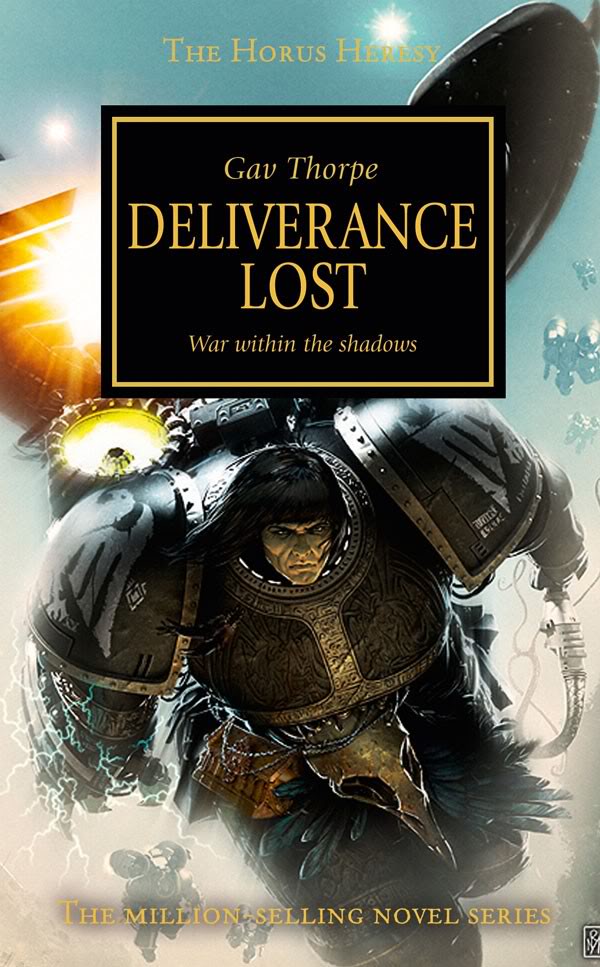
Since last I spoke of the Horus Heresy series, I have read not one, but two further novels in the series; The Outcast Dead, by Graham McNeill and Deliverance Lost by Gav Thorpe. And now I shall make discussion of them, as is traditional.
It's been a while
since I read them though, and I've read a few other things since then, so I'll
not do a full analysis (hahahaha shut up, you know what I mean) but rather just
a quick comparison between the two, and why they are, taken back to back,
such a good example of why I enjoy this series so much, even after having read
almost 20 books.
Which is not to say that they are good books,
necessarily.
In fact,
Deliverance Lost is pretty much the definition of a poor book, and The Outcast Dead,
while better; as you'd expect from Graham McNeill; is far from without it's flaws.
It's in their subject matter, rather than the quality of the work involved, that they serve as good examples of the Horus Heresy series' current charm; namely, it's versatility. In the early days of the series it ran the risk of, and often succumbed to, repetition; so many novels, by so many authors, all recounting this Space Marine battle or that one, but the wider ramifications of the great betrayal at the heart of the series, and the intricacies of how this Universe actually functioned, were never explored; or if they were it was in a perfunctory manner designed to give you just enough information to herd you to the next gunfight.
Of late, things have changed.
We'd had hints of a new direction for a while; notably, but not
exclusively, in the 13th book, Nemesis. It was with book 16 though;
novella collection Age of Darkness; that they fully embarked on their
new direction. These two books embrace that change wholeheartedly, with
TOD dealing with events among the 'little people' on Earth for the
first time, and DL, while it does deal with Space Marines and has a
couple of battles, has as it's main focus a story of obsession, genetic
engineering and espionage. As I said above, neither book is entirely
successful and DL falls apart completely at the end but it's pleasing
to see these new avenues being explored, and new story telling roads
being traveled.
I'm not suggesting for one second that Space Marine battles should be
excised completely from the series; it's entirely based on a tabletop
game involving Space Marines shooting each other; but it's nice that
they're acknowledging that they have created, perhaps by accident, a
Universe ripe for exploration. Some very good writers ply their trade
in the Warhammer/Warhammer 40,000 tie-in range; as well as some very
bad ones of course; and it should be interesting to see what they come
up with now that they're free to spread their wings. Mistakes will be
made, like Deliverance Lost, but when they find their rhythm I predict
some excellent space opera could be forthcoming. Can't wait.
Thursday, 4 October 2012
100 Bullets: Split Second Chances
Finally time to start writing up my thoughts on the second volumes of the
various comic series I'm reading in collected trade paperback form. First up,
as before, it's 100 Bullets. (Book one is here)

It's hard when you're reading something as old as 100 Bullets; the issues in this collection are well over a decade old; to avoid spoilers but I've pretty much managed not to find out any specifics of plot. I don't know, for example, what anyone's motivations are, or when major characters are going to get killed off, or anything like that. What I do know, though, is that this series does not adhere to it's seeming anthology format for the duration of it's run. There is a lot going on under the surface, and many clues are being laid. Even knowing this, though, I didn't expect the major background story to erupt as early as this 2nd book.
Of course, at first glance this collection seems much like the first. We open
on a two issue arc about ex con Chucky Spinks who learns from Agent Graves; he
of the irrefutable proof against those who wronged you and 100 untraceable
bullets to do with that information what you will; that he had been set up, and
just who exactly had done the framing. After some soul searching, we see
what he does about it. Just as with Dizzy Cordova and Lee Dolan in the first
book, things refuse to play out how you'd expect.
After a brief one issue stop over in which Graves sits down for a coffee with an old colleague and we learn a hell of a lot about the world he inhabits, although one suspects not nearly enough to so much as scratch the surface of what's really going on, it's back to business as usual. Someone has been wronged, and Graves is here to help.
Recipient this time is Cole Burns, ice cream man and seller of knock off cigarettes who is given evidence of a certain local mob bosses culpability in the death of a loved one.
Whatever will he do? I'm not telling, except to say that, well, it doesn't go well for him and things are looking bad. Until...
Lilly Roach is up next and her story is perhaps the darkest we've seen so far.
Her daughter ran away from home, and Lilly doesn't know why. Or maybe she
doesn't want to know. But Graves is going to make sure she can't hide from the
truth forever. Lilly begins and ends her story in one issue.
It's at this point that the series takes the turn that I knew was coming but didn't expect anywhere near this early. We meet a reporter who has been investigating the shady figures behind Graves, and previous recipients of his 'help' start showing up again; at least, those who survived the events of their opening stories; Dizzy is back, just in time to receive a dire warning, Cole Burns seems to be taking to his new circumstances rather well, and Graves' adversary, who may not be quite so much of an adversary as we were led to believe, is beginning to show his hand.
All told, I have absolutely no idea where things are going to go from here. With one character going through some very weird Manchurian Candidate/Bourne style mind altering freakery, and the growing idea that some kind of uber-conspiracy may be essentially running everything, this could go anywhere. I'm definitely along for the ride.
As is customary in my comics posts I shall now make my perfunctory 'I don't understand art but I know what I like' comment. I like this art. There, done. Eduardo Risso has, as you can see from the character panels above, a style which you couldn't really describe as 'realistic', but it complements Brian Azzarello's dark, twisty scripts, with their dark, twisty, tragic characters, to perfection. I wouldn't have thought it would, which shows what I know.
Next week; assuming I write a post, which lets be honest is never exactly a done deal; I shall be discussing The Outcast Dead, from the Horus Heresy series. Something for you to look forward to there.

It's hard when you're reading something as old as 100 Bullets; the issues in this collection are well over a decade old; to avoid spoilers but I've pretty much managed not to find out any specifics of plot. I don't know, for example, what anyone's motivations are, or when major characters are going to get killed off, or anything like that. What I do know, though, is that this series does not adhere to it's seeming anthology format for the duration of it's run. There is a lot going on under the surface, and many clues are being laid. Even knowing this, though, I didn't expect the major background story to erupt as early as this 2nd book.
 |
| Chucky Spinks |
After a brief one issue stop over in which Graves sits down for a coffee with an old colleague and we learn a hell of a lot about the world he inhabits, although one suspects not nearly enough to so much as scratch the surface of what's really going on, it's back to business as usual. Someone has been wronged, and Graves is here to help.
Recipient this time is Cole Burns, ice cream man and seller of knock off cigarettes who is given evidence of a certain local mob bosses culpability in the death of a loved one.
 |
| Cole Burns |
Whatever will he do? I'm not telling, except to say that, well, it doesn't go well for him and things are looking bad. Until...
 |
| Lilly Roach |
It's at this point that the series takes the turn that I knew was coming but didn't expect anywhere near this early. We meet a reporter who has been investigating the shady figures behind Graves, and previous recipients of his 'help' start showing up again; at least, those who survived the events of their opening stories; Dizzy is back, just in time to receive a dire warning, Cole Burns seems to be taking to his new circumstances rather well, and Graves' adversary, who may not be quite so much of an adversary as we were led to believe, is beginning to show his hand.
All told, I have absolutely no idea where things are going to go from here. With one character going through some very weird Manchurian Candidate/Bourne style mind altering freakery, and the growing idea that some kind of uber-conspiracy may be essentially running everything, this could go anywhere. I'm definitely along for the ride.
 |
| Mr Branch. May have uncovered more than is healthy. |
As is customary in my comics posts I shall now make my perfunctory 'I don't understand art but I know what I like' comment. I like this art. There, done. Eduardo Risso has, as you can see from the character panels above, a style which you couldn't really describe as 'realistic', but it complements Brian Azzarello's dark, twisty scripts, with their dark, twisty, tragic characters, to perfection. I wouldn't have thought it would, which shows what I know.
Next week; assuming I write a post, which lets be honest is never exactly a done deal; I shall be discussing The Outcast Dead, from the Horus Heresy series. Something for you to look forward to there.
Tuesday, 25 September 2012
Getting back to the olden days
Most of my non-genre reading (and by that I mean non sci-fi/fantasy, because
that is what 'genre' has come to mean in my head, so don't shoot me please) is
of the cop/thriller variety. I can't really pinpoint the exact moment that this
state of affairs came into being but I do know that it never used to be this
way.
In my younger years; for almost the entirety of my school life, in fact; I was all about the history. Naturally, sci-fi/fantasy was my first love, but when I did branch out, it was into the time streams, not onto a beat. Bernard Cornwell is of course the name that immediately springs to mind, so prolific was he; and so beloved of my local library, so never out of reach; but there were others.
Very few names have survived the gradual degradation of my memory cells, which is a shame as I vividly remember the feeling of reading and loving these works, and would dearly love to be able to recommend, and maybe even revisit some of them.
I do remember one particular series
that I was very much into; although I don't think I ever finished it; was the
Masters of Rome series, by Colleen McCullough, which charted the Roman Empire
over a hundred years or so. That's one I think I'll definitely return to.
I'm telling you this because having caught up, almost, with the crime series I came late to and had a backlog of (mostly Mark Billingham and Kathy Reichs stuff) I figured rather than the original plan of starting another big haul; contenders were the alphabet books by Sue Grafton or the Alex Cross books by James Patterson; I'd take the opportunity to return to the history books. I just have no idea where to start.
I have picked up a load of Cornwell books that he's brought out since I stopped reading him; because he apparently never stops writing, ever; but I'm wary of getting sucked into that trap of trying to keep up with a really prolific person and never reading anything else. So I took a plunge and picked up a couple of chunky omnibuses from authors I've never read that, while big in themselves, are at least complete. A trilogy called Viking, by Tim Severin, and a collection of short stories about a guy called McAuslan by Flashman author George MacDonald Fraser. I flipped a coin to see which got read first.
Viking it was. The first of the 3 novels contained in the book is called Odinn's Child. It's dull. It's brain freezingly dull. It is a novel, about Vikings. And it's dull. It has battles and feasts and quests. And it's dull. Reading this novel is legitimately one of the toughest challenges I've ever faced as a reader; the urge to toss it aside being so strong so much of the time. When I finished it, and was faced with the prospect of reading the second novel; Sworn Brother; I cried a little before shaking my head and admitting defeat. It stands neglected now upon my shelf awaiting it's return to my good graces.
I will read book 2. And after a no doubt equally essential sanity break, I will read book 3. But not yet. Oh no.
So the utter tedium of more Viking stories and the, one hopes, slightly more fun McAuslan stories await me in my future. Beyond that, who knows. Maybe I'll bow to the inevitable and sink into another Cornwell series. Anyone who wants to suggest something new, feel free in the old comment box below. I'll try anything once.
In my younger years; for almost the entirety of my school life, in fact; I was all about the history. Naturally, sci-fi/fantasy was my first love, but when I did branch out, it was into the time streams, not onto a beat. Bernard Cornwell is of course the name that immediately springs to mind, so prolific was he; and so beloved of my local library, so never out of reach; but there were others.
Very few names have survived the gradual degradation of my memory cells, which is a shame as I vividly remember the feeling of reading and loving these works, and would dearly love to be able to recommend, and maybe even revisit some of them.
 |
| Masters of Rome 1: The First Man In Rome |
I'm telling you this because having caught up, almost, with the crime series I came late to and had a backlog of (mostly Mark Billingham and Kathy Reichs stuff) I figured rather than the original plan of starting another big haul; contenders were the alphabet books by Sue Grafton or the Alex Cross books by James Patterson; I'd take the opportunity to return to the history books. I just have no idea where to start.
 |
| Bernard Cornwell's Grail Quest series. On the shelf. |
I have picked up a load of Cornwell books that he's brought out since I stopped reading him; because he apparently never stops writing, ever; but I'm wary of getting sucked into that trap of trying to keep up with a really prolific person and never reading anything else. So I took a plunge and picked up a couple of chunky omnibuses from authors I've never read that, while big in themselves, are at least complete. A trilogy called Viking, by Tim Severin, and a collection of short stories about a guy called McAuslan by Flashman author George MacDonald Fraser. I flipped a coin to see which got read first.
 |
| Can't Sleep? Take one chapter before bedtime. |
Viking it was. The first of the 3 novels contained in the book is called Odinn's Child. It's dull. It's brain freezingly dull. It is a novel, about Vikings. And it's dull. It has battles and feasts and quests. And it's dull. Reading this novel is legitimately one of the toughest challenges I've ever faced as a reader; the urge to toss it aside being so strong so much of the time. When I finished it, and was faced with the prospect of reading the second novel; Sworn Brother; I cried a little before shaking my head and admitting defeat. It stands neglected now upon my shelf awaiting it's return to my good graces.
I will read book 2. And after a no doubt equally essential sanity break, I will read book 3. But not yet. Oh no.
So the utter tedium of more Viking stories and the, one hopes, slightly more fun McAuslan stories await me in my future. Beyond that, who knows. Maybe I'll bow to the inevitable and sink into another Cornwell series. Anyone who wants to suggest something new, feel free in the old comment box below. I'll try anything once.
Friday, 7 September 2012
Hitman: A Rage In Arkham
COMICS! Because I haven't for a while.
Meet Tommy Monaghan. He kills people for money. It's a living.
Garth Ennis is the only writer to have two series in my graphic novel rotation at the moment; I spoke about current epic The Boys in an earlier post, while DC are currently collecting his 90's classic Hitman for what I believe is the first time; at least in the case of the later issues.
It's fabulous.

Tommy Monaghan is a hired gun, working freelance amongst the various feuding factions of the Gotham City (yes, that Gotham City) underworld. After a chance encounter with a not particularly friendly 'giant alien space vampire parasite' he gains certain powers that come in very handy in his line of work; namely x-ray vision and telepathy. He was already good at his job; now that he can see where you're hiding and hear what you're thinking, he's positively unstoppable. Or so he thinks.
 Tommy first appeared in DC's The Demon comic, in it's second annual and
then twice more before that title folded. This first volume collects
the first of these appearances only, skips the other two, throws in
Tommy's appearance in Batman Chronicles 4, and then launches into his
own series, Hitman, with the first 3 issue arc. The completist in me
might have balked at the two missing stories but in truth, I didn't
know about them when I read this book and you'd never notice from the
stories. Whatever happened in those missing tales, Ennis does a
flawless job of giving you everything you need to know to dive right
in.
Tommy first appeared in DC's The Demon comic, in it's second annual and
then twice more before that title folded. This first volume collects
the first of these appearances only, skips the other two, throws in
Tommy's appearance in Batman Chronicles 4, and then launches into his
own series, Hitman, with the first 3 issue arc. The completist in me
might have balked at the two missing stories but in truth, I didn't
know about them when I read this book and you'd never notice from the
stories. Whatever happened in those missing tales, Ennis does a
flawless job of giving you everything you need to know to dive right
in.
In fact, even had they omitted Tommy's 'origin' tale from Demon Annual #2 and picked straight up with Hitman #1, this book would have been as accessible a debut volume as I've read. Literally everything you need to know to start following the character is laid out for you in the minimum number of pages, without ever seeming like rushed exposition, and we're propelled straight into Tommy's first 'mission'. Someone has hired him to kill The Joker.
Yes, the Joker. Elements of the Batman mythos are all over this book. The man himself is on the cover, not to mention the story, where he receives less than reverential treatment from Tommy (and Ennis); the title, A Rage In Arkham (the name of the first arc) refers to Arkham Asylum, home away from lair for all of Bats' myriad of foes; and as mentioned, The Joker looms large over events towards the finale. Or does he?
It's a sensible, and most likely editorially mandated, route to take.
After all, if you're launching a new comic with an essentially all new
cast, it can't help to play up it's links to one of your biggest
characters. The assumption the reader makes is that, once the
introductions are made and Tommy and friends are established in their
own right, the Batman links will be pared back and phased out. These
characters are strong enough to stand on their own and tell their own
stories.
So what kind of stories are we talking here? Well, by virtue of being published as a Demon issue, the origin story is heavily reliant on the Supernatural, and the Rage in Arkham arc has as it's villains The Arkannone, a group of Lords of Hell, eager to recruit Tommy to their cause. However, there is nothing to suggest that the series will always focus on that aspect. One virtue of being set in the regular DC line is that there is a precedent for books of all genres. Superhero fare, gritty crime drama, war stories, and supernatural horror stand side by side in this world, and Tommy has a foot in all of those worlds. This series could go anywhere, and with Ennis writing, it almost certainly will.
Of course, this being the first book in the series, Tommy comes out on top and walks off into the sunset. None of his enemies are truly defeated though, and he's managed to make a few new ones along the way; it looks like there could be a very complicated road ahead for our hero.
And now for my traditional perfunctory appraisal of the art on offer; prefaced by the equally traditional caveat that no disrespect is intended, I just don't feel qualified to discuss art.
John McCrea is brilliant. His is a very cartoony style, which works wonders when the book is meant to be funny, which is often, but is also strangely well suited to depicting violent, bloody death.
In his introduction, artist Steve Dillon (frequent Ennis collaborator) talks of the 'acting ability' that comic book artists need to imbue in their characters, stressing that McCrea is very good at it. In my humble, unqualified opinion, he's absolutely right,as evidenced by Tommy's cheesy as hell grin when pretending not to know who Batman is. Taking the piss, and loving it.
And there you have my thoughts on the first Hitman collection. Another stonking start to what looks like being another stonking series from the always stonking Mr Ennis. Stonking.
Meet Tommy Monaghan. He kills people for money. It's a living.
Garth Ennis is the only writer to have two series in my graphic novel rotation at the moment; I spoke about current epic The Boys in an earlier post, while DC are currently collecting his 90's classic Hitman for what I believe is the first time; at least in the case of the later issues.
It's fabulous.

Tommy Monaghan is a hired gun, working freelance amongst the various feuding factions of the Gotham City (yes, that Gotham City) underworld. After a chance encounter with a not particularly friendly 'giant alien space vampire parasite' he gains certain powers that come in very handy in his line of work; namely x-ray vision and telepathy. He was already good at his job; now that he can see where you're hiding and hear what you're thinking, he's positively unstoppable. Or so he thinks.
In fact, even had they omitted Tommy's 'origin' tale from Demon Annual #2 and picked straight up with Hitman #1, this book would have been as accessible a debut volume as I've read. Literally everything you need to know to start following the character is laid out for you in the minimum number of pages, without ever seeming like rushed exposition, and we're propelled straight into Tommy's first 'mission'. Someone has hired him to kill The Joker.
Yes, the Joker. Elements of the Batman mythos are all over this book. The man himself is on the cover, not to mention the story, where he receives less than reverential treatment from Tommy (and Ennis); the title, A Rage In Arkham (the name of the first arc) refers to Arkham Asylum, home away from lair for all of Bats' myriad of foes; and as mentioned, The Joker looms large over events towards the finale. Or does he?
 |
| Kill The Joker? Fat Chance Mate |
So what kind of stories are we talking here? Well, by virtue of being published as a Demon issue, the origin story is heavily reliant on the Supernatural, and the Rage in Arkham arc has as it's villains The Arkannone, a group of Lords of Hell, eager to recruit Tommy to their cause. However, there is nothing to suggest that the series will always focus on that aspect. One virtue of being set in the regular DC line is that there is a precedent for books of all genres. Superhero fare, gritty crime drama, war stories, and supernatural horror stand side by side in this world, and Tommy has a foot in all of those worlds. This series could go anywhere, and with Ennis writing, it almost certainly will.
Of course, this being the first book in the series, Tommy comes out on top and walks off into the sunset. None of his enemies are truly defeated though, and he's managed to make a few new ones along the way; it looks like there could be a very complicated road ahead for our hero.
And now for my traditional perfunctory appraisal of the art on offer; prefaced by the equally traditional caveat that no disrespect is intended, I just don't feel qualified to discuss art.
John McCrea is brilliant. His is a very cartoony style, which works wonders when the book is meant to be funny, which is often, but is also strangely well suited to depicting violent, bloody death.
In his introduction, artist Steve Dillon (frequent Ennis collaborator) talks of the 'acting ability' that comic book artists need to imbue in their characters, stressing that McCrea is very good at it. In my humble, unqualified opinion, he's absolutely right,as evidenced by Tommy's cheesy as hell grin when pretending not to know who Batman is. Taking the piss, and loving it.
And there you have my thoughts on the first Hitman collection. Another stonking start to what looks like being another stonking series from the always stonking Mr Ennis. Stonking.
 |
| Garth Ennis |
 |
| John McCrea |
Thursday, 30 August 2012
The Girl Who Played With Fire
It's ironic that a novel with as tedious and
drawn out beyond all sane reason
an ending as The Girl With The Dragon Tattoo had should spawn a sequel that's
biggest, though by no means only flaw, is it's overly busy and rushed climax.
Yet that's exactly what you get with The Girl Who Played With Fire.

Leaving the end until the end though, what else is there to be said about The Girl Who Played With Fire?
Well, you could say that within it's 569 pages is a taut 250/300 page thriller fighting desperately to get out.
You could say that the peril befalling the protagonists veers worryingly close to cartoonish at times.
You could say that the plot relies *far* to heavily on coincidence.
You could even say that Mikael Blomkvist and Lisbeth Salander, so mesmerising as creations and so competent as characters in the first book, are compromised beyond repair.
The plot this time around, when it finally gets going, is a far more personal one for Salander, and delves much further into her history, her social circle such as it is, and the behavioural issues that saw the state declare her incompetent to manage her own life. All of which, sadly, is presented with all the dramatic flare of a cost/benefit powerpoint presentation at the AGM of a plastic spoon manufacturer. Persevere though, and there are some nuggets of gold.
Blomkvist, on the other hand, is brought into the plot entirely by a series of coincidences and he blunders around being even more of an arrogant, selfish tit than he was in the first book, while his sexual/relationship proclivities continue to present the burning question of why any woman with half an ounce of grey matter would give him the time of day.
Neither character comes out of this book looking particularly good, but they can at least rest easy in the knowledge that they are the leads so Larsson doesn't dare do as thorough a hatchet job on them as he does on every other character in the book. Every second man we meet is a sadistic misogynistic pig, and those who aren't are borderline incompetent; while the women, who are few and far between, spend all their time acting like gullible mugs. It's all well and good to tell us how smart and independent and savvy the women are, but when their every action belies that assertion, you're doing something wrong.
That last paragraph leaves something of a sour taste, because it would be obvious to a blind pheasant who only reads Urdu that Larsson has some pretty hefty anger towards what he sees as social injustices, whether motivated by misogyny or otherwise. His message is a good one. It's just a shame he isn't a better writer, and the whole thing comes off smacking of naivete.
The Girl Who Played With Fire is full of narrative dead ends as well. To give one, very prominent, example; the whole opening of the book. Not to put to fine a point on it, but it's entirely pointless. Salander is living it up in a secluded paradise with some of the money she nicked in book one when she figures out that one of the other guests at the hotel is planning to kill his wife. A storm hits, and Salander uses it as cover to kill him first.
Now, had this been used as a means of saying "Look, she's willing to kill, so she might be guilty of these crimes she's accused of" I could understand it, but that's never even intimated. Had the police discovered her crime, or at least suspected it, and used it to bolster their theories about her, I could have understood it. Neither of those things happen though, and you're left to wonder why Larsson bothered writing any of it.
From the beginning of the book, to the end of the book; it just stops. Absolutely nothing is resolved; he villains are still out and about being villainous, Salander is still on the run accused of murders she didn't commit (but not accused of the one she did) and while Blomkvist has figured out a fair amount of the story he's in absolutely no position to do anything about it. Come back for book 3 suckers!
In fact, you could spend almost as long relaying the books flaws as Larsson spent creating them. It would be pointless though, and not a little churlish; because you see, the book is eminently readable and immensely addictive. The flaws niggle and the flaws annoy, but they don't stop you reading. I'd like to tell you why but... I don't know. What meager critical faculties I might once have possessed have admitted defeat at the hands of this book and all I can say is... it's objectively rubbish, but if you read it, you'll probably enjoy it.

As I typed this post I came to a realisation that I didn't reach while actually reading; Larsson is a Star Wars fan! A standalone first story, followed by a sequel that digs into the lead's past, makes a massive reveal about their paternity, leaves another major character incapacitated, has no real ending to speak of and is pointless without the 3rd part. The Girl Who Played With Fire is The Empire Strikes Back! Only not as good, obviously.
Subscribe to:
Posts (Atom)