Friday, 9 November 2012

The Boys: Get Some


Comics this week, with Volume 2 of Garth Ennis and Darick Robertson's The Boys,  entitled 'Get Some', from the 4 part arc that opens the volume.


And what an arc it is! I've seen some criticism elsewhere on the internets, even from those who were complimentary about volume one, that this book sputters a little; that having used up all the obvious jokes in book one Ennis struggles to segue into an actual proper plot. I couldn't disagree more.

An investigation into the death of a young man that the police are suspiciously keen to close the file on leads cockney psycho Butcher and fish out of water new boy Hughie to poke their noses into the world of high-tech costumed vigilante Tek-Knight and his assorted allies and enemies. Which couldn't come at a worse time for Tek-Knight, who's having some 'emotional issues.' Namely, he can't stop fucking anything vaguely resembling a hole.

Unlike the majority of superhero characters that we've met so far, Tek-Knight seems like a relatively decent chap at heart, who's genuinely torn up about these compulsions; one suspects that any of the supes we met in book one would have embraced it, or not even noticed the difference, so depraved have they allowed themselves to become, but TekKnight does everything he can to resist. The scene of him undergoing therapy is, while very much played for laughs; the incongruity of him in his huge suit of armour, hunched up in a very proper Doctor's office is comedy gold in itself; you can't help but come to like the guy, and sympathise with him.

Tek-Knight gets some help
The ending to Tek-Knight's story is one big sex joke, it's true, but it's also a genuinely stirring and moving moment. That it is instantly undercut by more gags is par for the course; Ennis doesn't let you wallow; but that doesn't change what it is.

That's one of the things the Ennis detractors continue to be oblivious to; he uses the smut and the gore and the creepy sex gags to lull you into thinking you're reading a juvenile bit of fluff, so that it hits you even harder when moments of true joy, true sadness, or true beauty come at you. The criticism that his work is just swearing and tit jokes could have had some credence in the early years, when he was writing Hellblazer or Preacher, because he hadn't yet shown, as he would as those series developed, just what was going on under the surface; that those criticisms are still being thrown at him today beggars belief. And they are; I read a recent article to that effect when looking up some stuff for this post.

Anyway, with the murder solved and the Tek-Knight story ended we get another arc, and if I tell you it's called Glorious Five Year Plan I should think you'd be able to guess where our intrepid heroes are headed for this tale. Need another clue? It's really cold, and they're fond of vodka.


This story begins to delve into the deeper political machinations that are going on behind the scenes and show us that while the bulk of the action is US based, these 'bad guys' have global intentions. It also has an incredibly bloody finale, with a truly massive body count, which is always nice, but the true joy is in new character Vasili Vorishkin, aka Love Sausage, Communist superhero turned bar owner. I mean seriously, Love Sausage.

As I say, this story delves into the deeper workings of the conspiracy at work in The Boys world but as this is only the 2nd volume it doesn't give us too many answers. What it does do is make it abundantly clear that the people we need to fear, the people who are the true 'villains' of this series are not the superheroes, arrogant abuse of superhuman abilities notwithstanding, but the humans; the corporations in fact; that are pulling their strings. There's probably a message there somewhere.

I adore this series, I'm not going to lie to you. It can be hilarious one moment, moving the next, and horrific the moment after that: then it'll throw in a moment that's all three at once, just to keep you on your toes. I'm reading nothing else like it, and I really don't want it to end. Lucky for me then that I'm so far behind, and have so much still to come.

Wednesday, 24 October 2012

The Girl Who Kicked The Hornets Nest

I don't know what there is for me to say about The Girl Who Kicked The Hornets Nest that I haven't already said about ...Played With Fire. But here's my biggest problem.


I've never visited Sweden, let alone lived there. I am completely uneducated in it's politics or social customs. But here's the thing; I refuse to believe that it is anything at all as Stieg Larsson describes it in these books.

I'm not talking about the organised crime or the shady government agencies; that stuff happens everywhere, to a lesser or greater extent, and this is fiction after all so exaggeration for dramatic effect is to be expected. I'm talking about the fact that 2 out of every 3 male characters is a misogynistic pig of the vilest sort. We aren't talking sexist, 'put the kettle on love' or 'get em out for the lads' which would be bad enough but believable; we're talking vile woman hating scumbags.

 Not a chapter goes by without one character or another; be they Private Eye, Cop, Politician, Spy, Doctor, Social Worker or Drug Dealing Mass Murdering Psychopath; spout off about whores, bitches and cunts, and it just gets ridiculous. When everyone is as hateful as that, what possible impact can your 'main' villains have?

Of course it's always possible that Larsson made virtually every male character behave in that fashion because he understood that it was the only way to make his hero look good by comparison. Don't get me wrong, I like Mikael Blomkvist; when he's being a capable reporter and/or a doggedly pursuing proof of Salanders innocence. It's when he's doing anything else that he pisses me off big style. This is not giving your lead 'foibles' or having him be 'difficult'. This is having your lead be a total shit. Seriously, how does this man have friends? His sexual attitudes alone... I'm no prude, I once read a Jackie Collins novel, but I just want to punch this man whenever his attitude to sex, or monogamy, came up.

What of Lisbeth Salander though? Well for a start off she barely registers. Huge swathes of the book are people sitting around talking about her; take a drink every time someone uses the phrase 'lesbian satanist' and you won't live through the first 100 pages; but we don't see her actually do anything much of note until probably the last 50 pages or so. At which point Larsson realises she doesn't have her 'big scene' of the book; and other people have pretty much resolved her plot for her; so he contrives to give her one last 'kick-ass' fight scene against the unstoppable man mountain killing machine who feels no pain. Yeah.

And that's where it ends. We go from the title character in mortal danger, to the book being over and her (spoiler)  perfectly safe in the space of about 3 pages. Then she forgives a man she should by rights have been slapping the face of and the book's over. A far cry from the 'when will this bloody thing end?' feeling that the last 100 pages of book one engendered, but still far from perfect. Never did find that middle ground, this series.

So yeah, this book is one big bundle of flaws. Which is a crying shame, because it has a really intriguing plot at it's core, if you can forgive the horrible convenience of everyone in the world seemingly being connected to Salander in some way. He just never quite manages to dig the plot out from under the exposition and 'gritty' sex talk.

Anyway, that's the end of the Millennium trilogy. I didn't hate it, but I can't say it particularly blew me away either. Onwards and upwards though, because next week I talk about the 2nd trade paperback collection of The Boys. Good times.

Stieg Larsson

Friday, 19 October 2012

Fables: Animal Farm

Comics again this week, and I continue my reading of story lines everyone else read 10 years ago with Fables: Animal Farm, the second collection of the ongoing Fables series.

After introducing us to the likes of, among others, Snow White, King Cole, Prince Charming and Beauty and her Beast in first volume Fables in Exile it's now time to meet those Fables who can't really be expected to blend in to a normal New York setting. Yes, it's off to The Farm, to meet giants, dragons, a certain 3 pigs, and of course some porridge loving bears; one of whom has a more than platonic friendship going on with a certain blonde haired petty thief. Yes, they go there.


Following her actions in the first volume, Snow White decides that Rose Red needs straightening out, so it's family outing time as she drags her wayward sister along for the ride on her annual inspection of The Farm. Before they ever arrive though, Snow is convinced that something is wrong, and when they are greeted by a populace acting very strangely indeed her suspicions would seem to be confirmed. But just what is going on with the non-human fables? And will Snow and Rose be able to set aside their differences long enough to sort things out?

It seems that some of the fables confined to the farm are a little fed up of their lot; if they can't live openly in this world, then they want to return to their homelands. The Fable government won't allow this, at least not yet, so there is only one thing for it; armed revolution.

Having the 3 pigs; or 2 of them at least; as revolutionary ring leaders is, one suspects, one of the easier choices Bill Willingham had to make in the writing of this story but his choices of who else to include within the rebel party may surprise. While some are already villains in their original tales, such as Shere Kahn of Jungle Book fame; or, as in the case of the monkey king from that same tale, at the very least mischievous; others are very much the heroes and/or heroines of their stories. Indeed, one such 'heroine' is portrayed as the biggest psychopath of the entire tale, and it is glorious. She comes this close to stealing the show.

For a story that features the 3 little pigs as major players and has Chicken Little as it's comedy relief, this is pretty dark stuff. The revolutionaries are not messing about, with one minor character from the first book being dealt a nasty death early on, to reinforce that fact, and a truly shocking moment at the climax of the penultimate issue contained in this collection that I guarantee will make you sit up and swear at the page. Not to mention the aftermath; we get a reminder that the worlds these characters come from are not the sanitised, whitewashed, Disney-fied worlds of today's fairy tales when the heroes flat out execute the captured rebels. This is harsh reading.

Snow learns the truth. Or some of it.

One of the major villains gets away at the end; and it's my favourite, so I look forward to their future mis-deeds with some glee; but for the most part we see the status quo restored. One suspects this is a temporary measure however, because many seeds are sown that would seem to indicate troubled times ahead.

More to the point, we get a conversation that would indicate that a Fables immortality may well be linked to how powerful a hold they have over the public consciousness; so if your name is on every pre-schoolers lips and Disney are prepping a blu-ray of your animated classic, you can pretty much rest easy but if not... don't go getting into any duels any time soon. This conversation seems designed, at least to my tired and easily confused brain, to let us know someone major is going to die soon, and set us to guessing as to which major characters within the series are 'famous' enough to be safe. We'll see.

All told, this is another fabulous run of issues from the Fables team, and its easy to see from this just why the series has proven so massively popular over the years since; I for one am looking forward to seeing what new avenues will be explored, now that all of the characters, both human and non-human, have been introduced.

Join me here next week for, in a slight change of pace, The Girl Who Kicked The Hornets Nest. No pigs, bears, or beautiful princesses in that one.

Friday, 12 October 2012

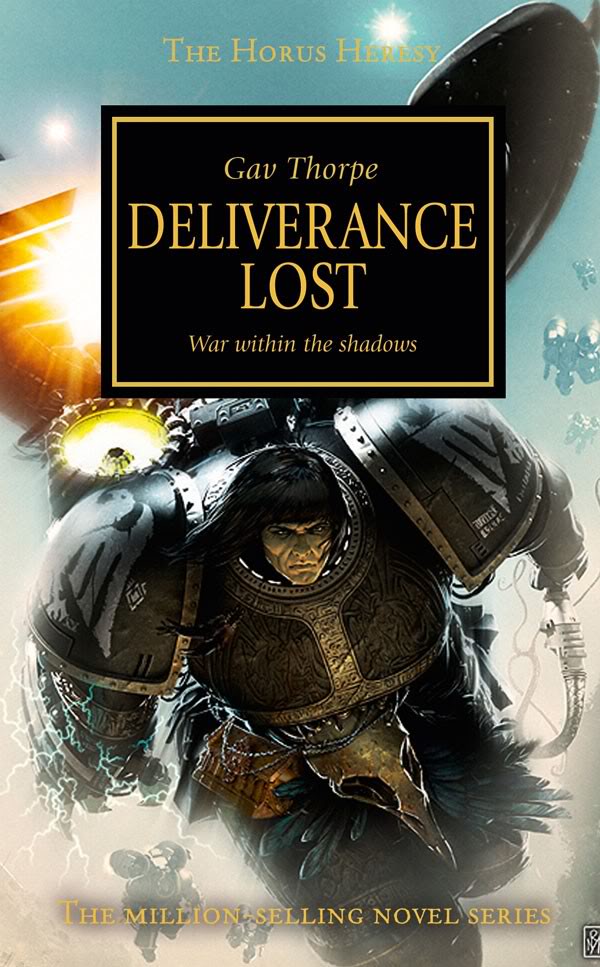
Horus Heresy: The Outcast Dead/Deliverance Lost


Since last I spoke of the Horus Heresy series, I have read not one, but two further novels in the series; The Outcast Dead, by Graham McNeill and Deliverance Lost by Gav Thorpe. And now I shall make discussion of them, as is traditional. 

It's been a while since I read them though, and I've read a few other things since then, so I'll not do a full analysis (hahahaha shut up, you know what I mean) but rather just a quick comparison between the two, and why they are, taken back to back, such a good example of why I enjoy this series so much, even after having read almost 20 books. 

Which is not to say that they are good books, necessarily. 

In fact, Deliverance Lost is pretty much the definition of a poor book, and The Outcast Dead, while better; as you'd expect from Graham McNeill; is far from without it's flaws. 


It's in their subject matter, rather than the quality of the work involved, that they serve as good examples of the Horus Heresy series' current charm; namely, it's versatility. In the early days of the series it ran the risk of, and often succumbed to, repetition; so many novels, by so many authors, all recounting this Space Marine battle or that one, but the wider ramifications of the great betrayal at the heart of the series, and the intricacies of how this Universe actually functioned, were never explored; or  if they were it was in a perfunctory manner designed to give you just enough information to herd you to the next gunfight. 

Of late, things have changed.

We'd had hints of a new direction for a while; notably, but not exclusively, in the 13th book, Nemesis. It was with book 16 though; novella collection Age of Darkness; that they fully embarked on their new direction. These two books embrace that change wholeheartedly, with TOD dealing with events among the 'little people' on Earth for the first time, and DL, while it does deal with Space Marines and has a couple of battles, has as it's main focus a story of obsession, genetic engineering and espionage. As I said above, neither book is entirely successful and DL falls apart completely at the end but it's pleasing to see these new avenues being explored, and new story telling roads being traveled. 

I'm not suggesting for one second that Space Marine battles should be excised completely from the series; it's entirely based on a tabletop game involving Space Marines shooting each other; but it's nice that they're acknowledging that they have created, perhaps by accident, a Universe ripe for exploration. Some very good writers ply their trade in the Warhammer/Warhammer 40,000 tie-in range; as well as some very bad ones of course; and it should be interesting to see what they come up with now that they're free to spread their wings. Mistakes will be made, like Deliverance Lost, but when they find their rhythm I predict some excellent space opera could be forthcoming. Can't wait.

Thursday, 4 October 2012

100 Bullets: Split Second Chances

Finally time to start writing up my thoughts on the second volumes of the various comic series I'm reading in collected trade paperback form. First up, as before, it's 100 Bullets. (Book one is here)


It's hard when you're reading something as old as 100 Bullets; the issues in this collection are well over a decade old; to avoid spoilers but I've pretty much managed not to find out any specifics of plot. I don't know, for example, what anyone's motivations are, or when major characters are going to get killed off, or anything like that. What I do know, though, is that this series does not adhere to it's seeming anthology format for the duration of it's run. There is a lot going on under the surface, and many clues are being laid. Even knowing this, though, I didn't expect the major background story to erupt as early as this 2nd book.

Chucky Spinks
Of course, at first glance this collection seems much like the first. We open on a two issue arc about ex con Chucky Spinks who learns from Agent Graves; he of the irrefutable proof against those who wronged you and 100 untraceable bullets to do with that information what you will; that he had been set up, and just who exactly had done the framing.  After some soul searching, we see what he does about it. Just as with Dizzy Cordova and Lee Dolan in the first book, things refuse to play out how you'd expect.

After a brief one issue stop over in which Graves sits down for a coffee with an old colleague and we learn a hell of a lot about the world he inhabits, although one suspects not nearly enough to so much as scratch the surface of what's really going on, it's back to business as usual. Someone has been wronged, and Graves is here to help.

Recipient this time is Cole Burns, ice cream man and seller of knock off cigarettes who is given evidence of a certain local mob bosses culpability in the death of a loved one.

Cole Burns

Whatever will he do? I'm not telling, except to say that, well, it doesn't go well for him and things are looking bad. Until...

Lilly Roach
Lilly Roach is up next and her story is perhaps the darkest we've seen so far. Her daughter ran away from home, and Lilly doesn't know why. Or maybe she doesn't want to know. But Graves is going to make sure she can't hide from the truth forever. Lilly begins and ends her story in one issue.

It's at this point that the series takes the turn that I knew was coming but didn't expect anywhere near this early. We meet a reporter who has been investigating the shady figures behind Graves, and previous recipients of his 'help' start showing up again; at least, those who survived the events of their opening stories; Dizzy is back, just in time to receive a dire warning, Cole Burns seems to be taking to his new circumstances rather well, and Graves' adversary, who may not be quite so much of an adversary as we were led to believe, is beginning to show his hand.

All told, I have absolutely no idea where things are going to go from here. With one character going through some very weird Manchurian Candidate/Bourne style mind altering freakery, and the growing idea that some kind of uber-conspiracy may be essentially running everything, this could go anywhere. I'm definitely along for the ride.

Mr Branch. May have uncovered more than is healthy.

As is customary in my comics posts I shall now make my perfunctory 'I don't understand art but I know what I like' comment. I like this art. There, done. Eduardo Risso has, as you can see from the character panels above, a style which you couldn't really describe as 'realistic', but it complements Brian Azzarello's dark, twisty scripts, with their dark, twisty, tragic characters, to perfection. I wouldn't have thought it would, which shows what I know.

Next week; assuming I write a post, which lets be honest is never exactly a done deal; I shall be discussing The Outcast Dead, from the Horus Heresy series. Something for you to look forward to there. 

Tuesday, 25 September 2012

Getting back to the olden days

Most of my non-genre reading (and by that I mean non sci-fi/fantasy, because that is what 'genre' has come to mean in my head, so don't shoot me please) is of the cop/thriller variety. I can't really pinpoint the exact moment that this state of affairs came into being but I do know that it never used to be this way.

In my younger years; for almost the entirety of my school life, in fact; I was all about the history. Naturally, sci-fi/fantasy was my first love, but when I did branch out, it was into the time streams, not onto a beat. Bernard Cornwell is of course the name that immediately springs to mind, so prolific was he; and so beloved of my local library, so never out of reach; but there were others.

Very few names have survived the gradual degradation of my memory cells, which is a shame as I vividly remember the feeling of reading and loving these works, and would dearly love to be able to recommend, and maybe even revisit some of them.

Masters of Rome 1: The First Man In Rome
I do remember one particular series that I was very much into; although I don't think I ever finished it; was the Masters of Rome series, by Colleen McCullough, which charted the Roman Empire over a hundred years or so. That's one I think I'll definitely return to.

  I'm telling you this because having caught up, almost, with the crime series I came late to and had a backlog of (mostly Mark Billingham and Kathy Reichs stuff) I figured rather than the original plan of starting another big haul; contenders were the alphabet books by Sue Grafton or the Alex Cross books by James Patterson; I'd take the opportunity to return to the history books. I just have no idea where to start.

Bernard Cornwell's Grail Quest series. On the shelf.

I have picked up a load of Cornwell books that he's brought out since I stopped reading him; because he apparently never stops writing, ever; but I'm wary of getting sucked into that trap of trying to keep up with a really prolific person and never reading anything else. So I took a plunge and picked up a couple of chunky omnibuses from authors I've never read that, while big in themselves, are at least complete. A trilogy called Viking, by Tim Severin, and a collection of short stories about a guy called McAuslan by Flashman author George MacDonald Fraser. I flipped a coin to see which got read first.

Can't Sleep? Take one chapter before bedtime.

Viking it was. The first of the 3 novels contained in the book is called Odinn's Child. It's dull. It's brain freezingly dull. It is a novel, about Vikings. And it's dull. It has battles and feasts and quests. And it's dull. Reading this novel is legitimately one of the toughest challenges I've ever faced as a reader; the urge to toss it aside being so strong so much of the time. When I finished it, and was faced with the prospect of reading the second novel; Sworn Brother; I cried a little before shaking my head and admitting defeat. It stands neglected now upon my shelf awaiting it's return to my good graces.

I will read book 2. And after a no doubt equally essential sanity break, I will read book 3. But not yet. Oh no.

So the utter tedium of more Viking stories and the, one hopes, slightly more fun McAuslan stories await me in my future. Beyond that, who knows. Maybe I'll bow to the inevitable and sink into another Cornwell series. Anyone who wants to suggest something new, feel free in the old comment box below. I'll try anything once.

Friday, 7 September 2012

Hitman: A Rage In Arkham

COMICS! Because I haven't for a while.

Meet Tommy Monaghan. He kills people for money. It's a living.

Garth Ennis is the only writer to have two series in my graphic novel rotation at the moment; I spoke about current epic The Boys in an earlier post, while DC are currently collecting his 90's classic Hitman for what I believe is the first time; at least in the case of the later issues.

It's fabulous.

Tommy Monaghan is a hired gun, working freelance amongst the various feuding factions of the Gotham City (yes, that Gotham City) underworld. After a chance encounter with a not particularly friendly 'giant alien space vampire parasite' he gains certain powers that come in very handy in his line of work; namely x-ray vision and telepathy. He was already good at his job; now that he can see where you're hiding and hear what you're thinking, he's positively unstoppable. Or so he thinks.

Tommy first appeared in DC's The Demon comic, in it's second annual and then twice more before that title folded. This first volume collects the first of these appearances only, skips the other two, throws in Tommy's appearance in Batman Chronicles 4, and then launches into his own series, Hitman, with the first 3 issue arc. The completist in me might have balked at the two missing stories but in truth, I didn't know about them when I read this book and you'd never notice from the stories. Whatever happened in those missing tales, Ennis does a flawless job of giving you everything you need to know to dive right in.

In fact, even had they omitted Tommy's 'origin' tale from Demon Annual #2 and picked straight up with Hitman #1, this book would have been as accessible a debut volume as I've read. Literally everything you need to know to start following the character is laid out for you in the minimum number of pages, without ever seeming like rushed exposition, and we're propelled straight into Tommy's first 'mission'. Someone has hired him to kill The Joker.

Yes, the Joker. Elements of the Batman mythos are all over this book. The man himself is on the cover, not to mention the story, where he receives less than reverential treatment from Tommy (and Ennis); the title, A Rage In Arkham (the name of the first arc) refers to Arkham Asylum, home away from lair for all of Bats' myriad of foes; and as mentioned, The Joker looms large over events towards the finale. Or does he?


Kill The Joker? Fat Chance Mate
It's a sensible, and most likely editorially mandated, route to take. After all, if you're launching a new comic with an essentially all new cast, it can't help to play up it's links to one of your biggest characters. The assumption the reader makes is that, once the introductions are made and Tommy and friends are established in their own right, the Batman links will be pared back and phased out. These characters are strong enough to stand on their own and tell their own stories.

So what kind of stories are we talking here? Well, by virtue of being published as a Demon issue, the origin story is heavily reliant on the Supernatural, and the Rage in Arkham arc has as it's villains The Arkannone, a group of Lords of Hell, eager to recruit Tommy to their cause. However, there is nothing to suggest that the series will always focus on that aspect. One virtue of being set in the regular DC line is that there is a precedent for books of all genres. Superhero fare, gritty crime drama, war stories, and supernatural horror stand side by side in this world, and Tommy has a foot in all of those worlds. This series could go anywhere, and with Ennis writing, it almost certainly will.

Of course, this being the first book in the series, Tommy comes out on top and walks off into the sunset. None of his enemies are truly defeated though, and he's managed to make a few new ones along the way; it looks like there could be a very complicated road ahead for our hero.

And now for my traditional perfunctory appraisal of the art on offer; prefaced by the equally traditional caveat that no disrespect is intended, I just don't feel qualified to discuss art.

John McCrea is brilliant. His is a very cartoony style, which works wonders when the book is meant to be funny, which is often, but is also strangely well suited to depicting violent, bloody death.

In his introduction, artist Steve Dillon (frequent Ennis collaborator) talks of the 'acting ability' that comic book artists need to imbue in their characters, stressing that McCrea is very good at it. In my humble, unqualified opinion, he's absolutely right,as evidenced by Tommy's cheesy as hell grin when pretending not to know who Batman is. Taking the piss, and loving it.

And there you have my thoughts on the first Hitman collection. Another stonking start to what looks like being another stonking series from the always stonking Mr Ennis. Stonking.

Garth Ennis

John McCrea